The Chameleons of Madagascar
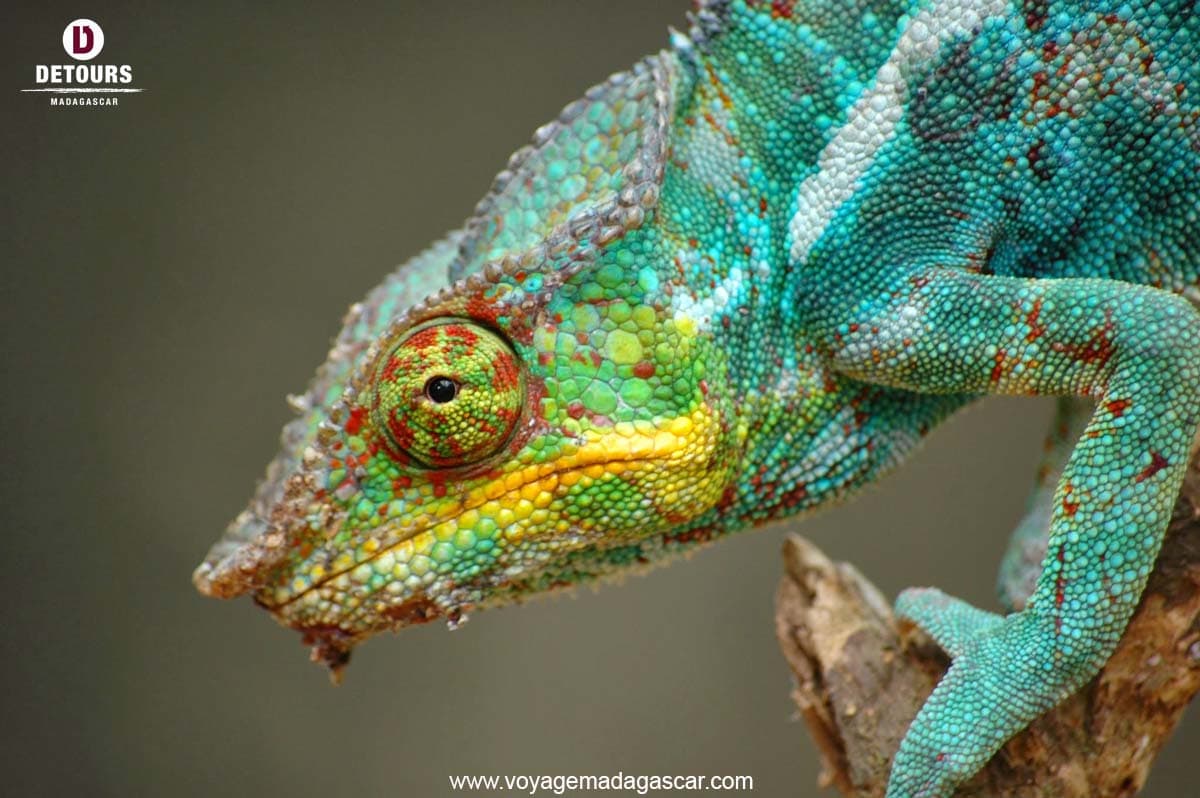
Chameleons are among Madagascar's natural wonders, varying in size and color, as well as in the shape of their heads. They can be found in all Malagasy national parks and even in any lush vegetation in cities.
Chameleons are among the natural wonders of Madagascar, varying in size and color, as well as in the shape of their heads. You'll encounter them in all Malagasy national parks and even in any lush vegetation in cities. Approximately half of the world's 150 chameleon species are found in Madagascar, including 59 endemic species!
What is the size of chameleons?
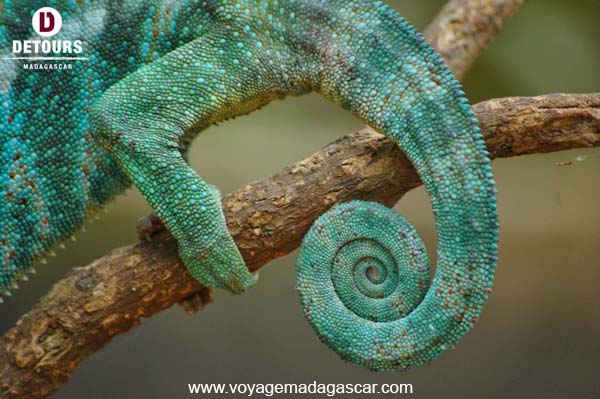
It's always fascinating to observe them, especially when they're unusually large or displaying beautiful colors, or when they're hunting. Before your stay in Madagascar, you've surely already seen these miniature dinosaurs on television. The largest measures up to 69 cm, while the smallest barely reaches 20 mm. Most of the time, the male is always larger and bigger than the female. Their tail can curl on itself and serve as a limb to grip branches.
Chameleons are multicolored
Their colors range from white to black, passing through red, brown, yellow, blue, and green. It's important to know that chameleons cannot imitate all colors and they don't do so primarily to camouflage themselves. Colors serve to communicate between them: fear, desire to mate, and so on. They can change color rapidly thanks to their epidermis composed of two layers of nanocrystals, reflecting light in the near infrared.
Their tongue and vision
Their eyes are prominent and can move independently, allowing them to see in two different directions (the future and the past according to a Malagasy myth) and to cover a 360° field of vision. When a chameleon spots prey (insects of all kinds, grasshoppers and crickets, small lizards and geckos, and even small birds for the largest species), it measures the distance with precision and projects its tongue (longer than its body) spectacularly (20 to 100 km/h). It never misses its target. However, it can see nothing at night!
Crest, horn, and helmet
Your trip to Madagascar will certainly lead you to discover the most impressive species if you visit parks, reserves, and zoos. All chameleons possess a kind of helmet, a thick structure covering their head. Some are equipped with one or two horns, with the longest measuring 3 cm, particularly on the Trioceros jacksonii. As for crests, they are rigid and prominent on certain species such as the Chamaeleo calyptratus.
The different chameleons
Madagascar chameleons are divided into three genera: Furcifer, Calumma, and Brookesia. The first groups the largest specimens, while the second is distinguished by their horns, whereas the third is the smallest. If you want to know the genus of chameleons you'll discover during your tour in Madagascar, among others:
- The Furcifer angeli in Ankarafantsika National Park (northwest)
- The Furcifer antimena in the PAD (Protected Area) Ranobe PK32 and Mikea (southwest)
- The Furcifer campani in Andringitra National Park (south-central)
- The Calumma amber, endemic to Amber Mountain (north)
- The Calumma capuroni in Andohahela National Park (far southeast)
- The Brookesia bekolosy, endemic to Manongarivo Special Reserve (north)
- The Brookesia exarmata, endemic to Tsingy de Bemaraha National Park (west)