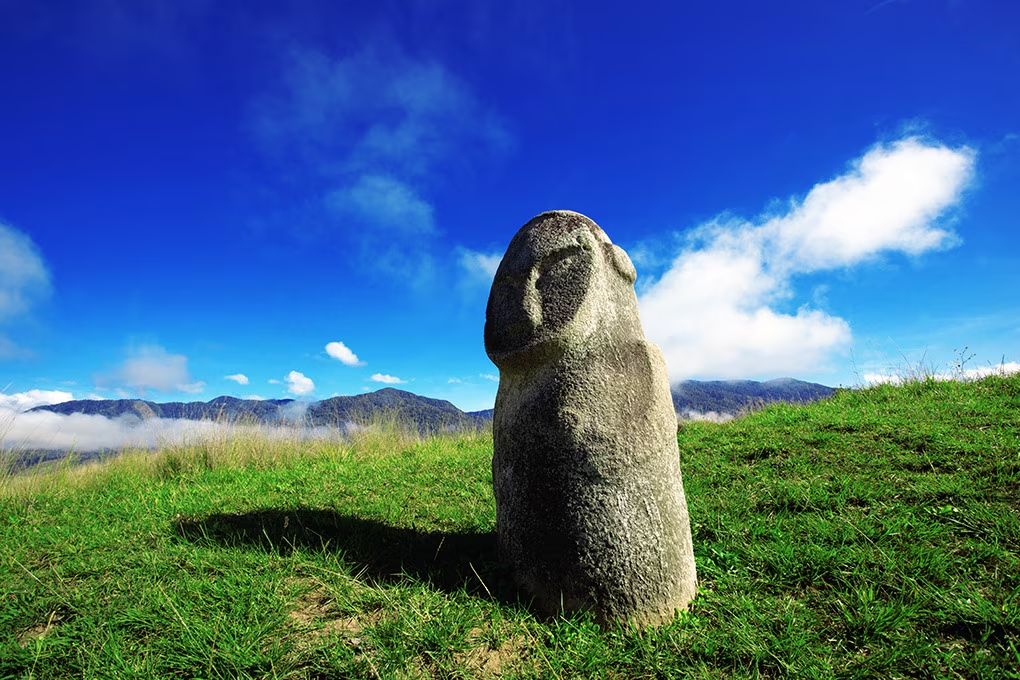
The Great Exceptional Hikes, Andringitra, Isalo and Makay
Duration
23 days
From
€3,000/pers.
The spirit of travel
Madagascar, a trekking destination…
Madagascar is a true trekking and hiking destination. This extraordinary journey allows you to connect the emblematic massifs of the Great Island.
The Andringitra massif offers hiking in an alpine atmosphere. The immense mountain range, formed by crystalline bedrock, reveals the grey of its granite. The Pic Boby dominates the surrounding plains majestically.
The Isalo Natural Park, meanwhile, has a completely different geomorphology. The ruiniform sandstone plateaus of Isalo and Makay are similar to the great Saharan Tassili massifs, the Ajjer, Tassili du Hoggar, Adrar Mauritanian plateau and especially the Ennedi massif in Chad.
These specific environments allow for beautiful trekking expeditions on foot. Isolated and highly distinctive, the Makay plateau is full of hidden treasures. With extraordinary biodiversity, it takes us through a maze of canyons, plateaus and labyrinths populated by unique fauna and flora.
This trip also allows you to experience wonderful moments of sharing with our teams, our porters, our guides. Here we find the so appealing atmospheres of caravans and trekking journeys.
---XXX---
This trip is of Demanding level: 5 to 8 hours of hiking per day. Excellent physical condition required as stages can be long. You must be able to maintain this pace for several days.
Positive elevation gain can reach 900 meters.
The stages of your journey
Day-by-day itinerary

Flight departing from Paris CDG heading to Antananarivo (Flight AF)
Flight to Antananarivo, dinner and overnight on board.
Program developed with Air France.
The Détours Madagascar Team welcomes you upon arrival. Check-in at your hotel.

Full South, crossing the Central Highlands of Madagascar to Antsirabe
We head towards the city of Ambatolampy, located south of Antananarivo.
We cross the typical landscapes of the Central Highlands by taking a winding road bordered by a mosaic of fields and diverse crops, rice paddies arranged in terraces.
We set out to meet a dynamic and ubiquitous rural world. As we approach Antsirabe, various agricultural productions spread out along the roadside.
We reach Antsirabe, the thermal city, nestled in the center of the Highlands.

Continuation on Fianarantsoa, the Betsileo Capital
Heading south on RN7, we encounter a mountainous landscape with a beautiful alternation of lovely agricultural valleys and mountain pass passages.
The road is beautiful and allows for a gentle approach to the southern part of the Highlands. We enter the Betsileo country, the majority ethnic group of the southern high plateaus.
Here, life is rhythmed by rice cultivation and zebu herding.
Fianarantsoa stands out on a cluster of hills that can remind one of Antananarivo.
Like Antananarivo, the city is divided into three parts:
The upper town, where the Merina governor's palace once stood, and where today you can admire Protestant temples, a Lutheran college, the brick cathedral in Tuscan style, the Jesuit school of Ambozotany and Antsenakely square, where a small market is held.
The new town, an administrative district, where you can also find the zoma (Friday market),
The lower town, Ampasambazaha, the heart of the city where you will find the Chinese and Indian trading quarters.

Andringitra Mountains, first half-day trek
Through the patchwork of terraced rice fields and diverse crops where every shade of green is displayed, heading to Ambalavaoknown for its vineyards.
FromAmbalavao, we leave National Route 7. The chaotic track takes us to the village of Ambalamanandray, at the eastern gate of the Andringitra MassifThe Andringitra Massif.
Walking tour
At the entrance to the Andringitra National Park, our local team joins us, composed of a park guide and porters. For a first warm-up, we begin our hike on a beautiful trail between forests and waterfalls to reach the intermediate plateau of Andriampotsy, the base camp of Pic Boby.

Trekking in Andringitra, Boby Peak (2658m.)
Early in the morning, we head towards the 2nd highest peak in Madagascar, Pic Boby or Imarivolanitra. It reaches 2,658 m.
This beautiful hike is on a well-maintained trail.
We set out very early to enjoy the view from the summit.
If the sky is clear enough, we can see the East Coast.
We now reach a surreal lunar plateau that deserves the nickname of "extraterrestrial" so fantastic are the erosions. We then cross the Ravenea glauca palm forest, endemic to this region, until we reach our bivouac site in Iantaranomby on the banks of a beautiful river where we can cool off.

Granite foothills to the stunning Tsaranoro valley
Iantaranomby → Vallée De Tsaranoro
Heading west, we continue our descent towards the magnificent Tsaranoro Valley. Late morning, we meet up with our vehicles.
We say our goodbyes to the guide and porters who accompanied us during our trekking in Andringitra.
To Ranohira
The road to the southwest enters the Bara country and crosses the largest plateau in Madagascar, the Plateau de l'Horombe.
The vast expanses of savannas and grassy steppes are the places traversed by this great ethnic group of zebu herders of Bantu origin. The village of Ranohira is located on the outskirts of the ruiniform massif of Isalo.
Picnic lunch
Isalo National Park, the Little-Known Canyons
We resume the trail heading north of Isalo, accompanied by our porters and the park guide. The trail runs along the eastern cliff of the Isalo massif. We reach the village of Andriamanero.
On foot, we reach our bivouac site. At the end of the day, we set up our tents. The northern part of the Isalo plateau is wild and little-known.

On foot discovering Sahanafo forest and Portuguese Cave
We begin our hike towards the Ambovo plateau which we will follow to reach the viewpoint of Amparambatomanara. Cliffs, Tapia forests, savannas and eroded rocks with strange shapes…
This itinerary is also a live slideshow of plants "adapted" to the arid climate. We arrive in the Ankotrakotraka canyon. Visit to the Portuguese Cave, developed by navigators who shipwrecked on the southwest coast of the island and took refuge here in the 16th century.
Camp setup for the night.
The High Plateaus of Isalo and the Eastern Edge
We will explore the Sahanafo Forest to try to discover Sifaka, lemurs propithecus, in their natural habitat.
Return to the camp for lunch then we start our walk towards the Ambovo plateau where we set up our camp for the night.

After Isalo, on track for the Mangoky River and the south of Makay
Early in the morning, we resume the hike towards Tameasoa where our vehicles await us.
Car transfer to the village of Beronono, passing by the Mangoky River, the longest river on the West coast. The crossing is made by ferry before reaching Beroroha, the capital of the district in the region.
Arrival in late afternoon at Beronono, camp set up right on the banks of the Makay River.

On foot towards the caves and rock art sites of South Makay
We will begin the hike along the Makay river. Then continue towards a small forest that leads us to the foot of the Mahatiny cave. A place where one of the oldest rock paintings still exists, most of whose drawings show us simply geometric figures…
Then in the afternoon, we take a small path that brings us to a ridge section where we will have an overview of the massif. At the end of the afternoon, return to the banks of the Makay river. Tent setup.

Between canyons and plateaus, the lakes of Anosilahy
After breakfast, we start with a short walk through the reeds before continuing along a long ridge section, where you'll enjoy magnificent views of two lakes. Here, parrots are omnipresent, their cries echoing through these long corridors. A few birds of prey such as buzzards, kites and striped polyboroides glide above the mountains.
In the afternoon, a short technical descent before arriving at Anosilahy Lake. Then we climb back up a small river which leads us to the bivouac site.


Towards the Bara villages on the eastern border
To Beronono
We reach the village of Beronono, the last stop on the southern part of the massif, a half day's hike awaits us.
In the afternoon, we could cool off on the banks of the Makay River. Evening entertainment with our porters and guide.

By 4x4 to reach a little-known Makay
Early in the morning, we break camp and say goodbye to our porters and villagers. Departure for a long day of fairly difficult 4x4 track running parallel to the massif, we cross small dry forests, some villages and even sometimes almost abandoned trails.
In the afternoon, before arriving at camp, we pass through the small town of Mandronarivo, where fresh drinks await us.
Arrival at the bivouac site, tent setup, spectacle of a splendid sunset.

On foot, approaching the most spectacular part of the Makay
From there, our trekking adventure in the north of the Makay massif begins. Along a riverbed with white sand, we venture between the high mottled sandstone cliffs. This major fissure allows us to access the Andranomite Cave. It has always served as shelter for people crossing the Makay massif from east to west.
We now plunge into the heart of the massif, a network of dry canyons descends into the wildest part of the Makay. The highest point of Makay dominates our path. Multiple varieties of palm trees and ferns populate the gorge banks, water is now present.
Our camp is set up on the banks of the river between the great dark cliffs.

The balcony trails, the canyons... in the heart of the Makay biodiversity
Janjy (Makay) → Ampandramaneno
From the bivouac, we leave the riverbed to follow a slope leading to the ridge line 400 meters higher.
A technical passage without difficulty will add some spice to our progress, a safety rope allows us to cross this short rocky section. We now follow a splendid balcony trail that overlooks the eastern plain bordering the plateau. The atmospheres are superb, the distant horizons.
A few palmyra palms on a wide pass mark a new hydrographic basin, new gorges. In these wooded gorges, we will have a good chance of finding lemurs. Two species coexist, the Fulvus rufus and the Prophitecus verraux.

Water trekking in Sakamaly major fissure
This great day takes us west of the ruiniform sandstone barrier. The deep gorge of the Sakamaly River cuts deeply into the massif. A truly aquatic day, this fissure shelters a beautiful forest with majestic trees. Families of lemurs populate the visible treetops from time to time. Crocodiles are also present, and we will see traces of them.
Nevertheless, we must be careful of certain plants present in the Makay massif, including bararata, prickly reeds. Takilotra are a variety of itching hair and karibo, a type of thorny vine often found hidden in grasses.

The labyrinthine Sakasaka to reach the majestic gorge of Sakapaly
Early in the day, after a couple of hours of hiking in the savanna, we reach a very rugged region, a tangle of cracks, ridgelines similar to great labyrinths, the sakasaka. A winding path gives us access to the major fault of Sakapaly which flows to the east of the massif. The 360° panoramas are magnificent. Canyons, faults, summits and peneplains succeed one another.
We establish our bivouac in a wide wooded valley on immaculate white sand.

Towards the north always, Manampanda
Our caravan makes its way through the cliffs, an easy route, and we set foot on the plateau. The objective is now to reach a narrow crevasse, covered with pandanus, palm trees and ferns that opens the passage to the large watershed basin of Manampanda.
Our progress takes place entirely with our feet in the water, in a lush vegetation environment. The lemurs, very present, disappear into the canopy. At our feet, trapped in the blocks of the river bed, petrified wood bears witness to the remains of a fossil forest. These silicified witnesses are very useful for the study of geology, paleobotany and paleoenvironment. Needless to say, this unique heritage must be protected. Our tributary joins the Manampanda river and the water flow suddenly becomes much more significant.
Our camp is established on a beautiful sandy beach along the river.

On foot, the far north of the Makay Massif
The Manampandana River guides our progress for about an hour before we leave it to reach the plateau. After reaching the ridge line, we head towards the Bara villages on the northern edge of the Makay Massif.
We reach the village of Tsiazorambo in the early afternoon. Our vehicles are there, waiting for us.
This is the end of our unique and unprecedented journey through this magnificent Makay Massif. The evening is dedicated to conviviality and the joy of having lived a beautiful adventure together, you, the porters, the tracker, the guide and the logistics team Détours Madagascar.

By car, the track then the road towards the Highlands
After breakfast, we pack up the tents and say goodbye to the porters and guides. We get back into our 4x4s to take the northern exit track, in order to reach the town of Malaimbandy before crossing the national road 34 which takes us to Miandrivazo.
In the afternoon we continue to Antsirabe, the capital of the Vakinankaratra region, the final stop for the day.
Picnic

Return to Malagasy Capital and evening return flight to Paris
A short tour of the city and visit to <local craftsmen (making miniatures of bikes and cars, working with zebu horn…) then drive to Ambatolampy.
Rice paddies and characteristic villages of the Highlands shape the landscape.
To Antananarivo
Afternoon continuation towards Antananarivo. If time permits, visit to the craft market.
Evening transfer to the airport, assistance with boarding on the flight to Paris.
Price per person
Indicative price per person, based on double room. Each trip is customized according to your preferences.
This trip can be tailored to your preferences
This itinerary provides an excellent foundation for discovery, but it can be fully customized. Our local advisors build each trip tailored to your budget, dates and preferences.
Not included
- Flights (international/regional)
- The dinner on D1 (on board) and the dinner on D23
- Entrance tickets for Makay (no protected area manager until further notice)
- Activities not mentioned in the program
- The single supplement or single room distribution (in hotels and tents) = €250 per person
- Beverages, tips, and personal expenses
- Cancellation insurance, repatriation and first aid costs
- Visa fees
Included
- The services of an English-speaking driver-guide throughout the trip
- The service of an English-speaking trek guide during trekking in the Makay massif
- Travel by 4x4 vehicle(s) throughout the trip
- Accommodation in double/twin rooms in hotels (or similar depending on availability at the time of booking)
- Nights under canvas, camping equipment provided (bring a sleeping bag)
- Full board except dinner on D1 (on board) and dinner on D23
- Throughout the entire stay in the mountains, the vehicles remain at locations determined by us
- Picnic lunches during certain transfer stages and hiking days for the smooth running of the trip
- Entrance fees in parks and reserves, including mandatory local guide fees (except in the Makay massif)
- The team of porters, local guide and cook during the trekking and hiking days
- All logistics and supplies for this type of trip
- The visits and activities as described in the program
- All transfers.
Practical Information
Registration is considered firm and final after payment of a deposit of 30% of the total price and acceptance of the specific terms of sale.
The balance must be paid no later than 45 days before the departure date.
See our specific terms of sale for full details.
In the event of cancellation by the traveller, the following fees apply:
More than 60 days before departure: 30% of the total price (deposit retained)
Between 60 and 30 days before departure: 50% of the total price
Less than 30 days before departure: 100% of the total price
We strongly recommend taking out cancellation insurance. See our specific terms of sale for full details.
Your Passport:
Important: your passport must be valid. It must be mandatory and obligatorily valid for 6 months after the end of your stay in Madagascar.
Your travel documents
Your valid passport,
Your international and/or domestic flight tickets,
Your repatriation insurance/first aid expenses contract, -
Your vaccination record, not mandatory,
Your blood group card if possible.
Obtaining a visa to enter Malagasy territory
Upon arrival in the territory:
The visa cost is €35 for a stay of less than 30 days.
It is easily obtained upon your arrival in Malagasy territory.
This applies to all airports in Madagascar that receive international flights.
Upon arrival in the terminal, upon exiting the plane, a corridor for passengers is dedicated to issuing tourist visas.
This procedure is the simplest. We recommend it to you.
From the embassies and consulates of your countries of origin:
For information, download the document explaining the procedure and the constitution of the file for obtaining a visa from the Madagascar embassy.
To participate in our trips, it is strongly recommended to be insured for repatriation assistance and medical expenses abroad.
Your local agency encourages you to familiarize yourself with the specific contract developed with our partner CHAPKA ASSURANCES and AXA ASSISTANCE.
To subscribe to insurance, learn about coverage and rates, follow the link below.
CAP EXPLORER: The comprehensive insurance solution designed to enjoy your trip with peace of mind!
Choose the plan that best suits you:
Explorer'Multirisque
Explorer'Annulation
Explorer'Assistance
Explorer' Complementary Credit Card
Specific to our trips, we strongly recommend subscribing to them.
If you choose to subscribe to one of these plans, the policy detailing all coverage and procedures for claiming any loss are available on the insurer's website.
Your local agency will be aware of it, but only the participant is responsible for complying with the procedures for declaring any loss. The participant must therefore keep this policy with them throughout their trip.
Chapka — Cap Explorer
Our insurance partnerTravel with peace of mind with our partner Chapka. Cancellation, repatriation, medical expenses, baggage… All the coverage for a worry-free trip.
Travel with peace of mind — I'll handle the insuranceFrequently asked questions
A tourist visa is required, issued upon arrival at Ivato Airport (Antananarivo) or online (e-visa). Your passport must be valid for at least 6 months from your date of entry. Before booking your trip, check with Madagascar's consular authorities for the conditions applicable to your nationality, including visa fees and authorized lengths of stay.
Go to the My Trips section to find all your projects.
You can send a message to your host directly from the Tea Lounge.
For a tailor-made quality trip, expect between 160 and 270 euros per day and per person, including accommodation, meals, internal transfers and English-speaking guide. International flights (900-1400 euros return) are additional. Long transfers and domestic flights represent a significant portion of the budget.
Your documents are accessible in the Documents tab of your trip.
Absolutely. We adapt each itinerary to suit your travel profile. For families, we prioritize relaxed pacing, family-friendly accommodations, fun and educational activities, and comfortable private transfers. Our local English-speaking guides know how to captivate children with age-appropriate anecdotes.
It's simple. You exchange with our local team to define your wishes, budget and dates. You receive a detailed itinerary proposal within 48 hours. You adjust every detail together until it's perfect. You confirm and travel with peace of mind. Your local agency remains available 7 days a week throughout your trip.
In case of emergency, contact your local agency immediately.
Payment is generally made in two installments.
Our agency is part of the Nomadays network, registered in France. You benefit from APST (Association Professionnelle de Solidarité du Tourisme) protection, which covers 100% of your funds. Secure payment, repatriation insurance included, and English-speaking assistance 24/7 on the ground throughout your stay.
Let's talk about your next trip to Madagascar
Ambassador of Malagasy fihavanana, based in Antananarivo
For me, traveling to Madagascar is stepping into the spirit of fihavanana: sharing, helping one another, meeting people, and taking time to understand what connects them to their land.
— Noro