Central Highlands
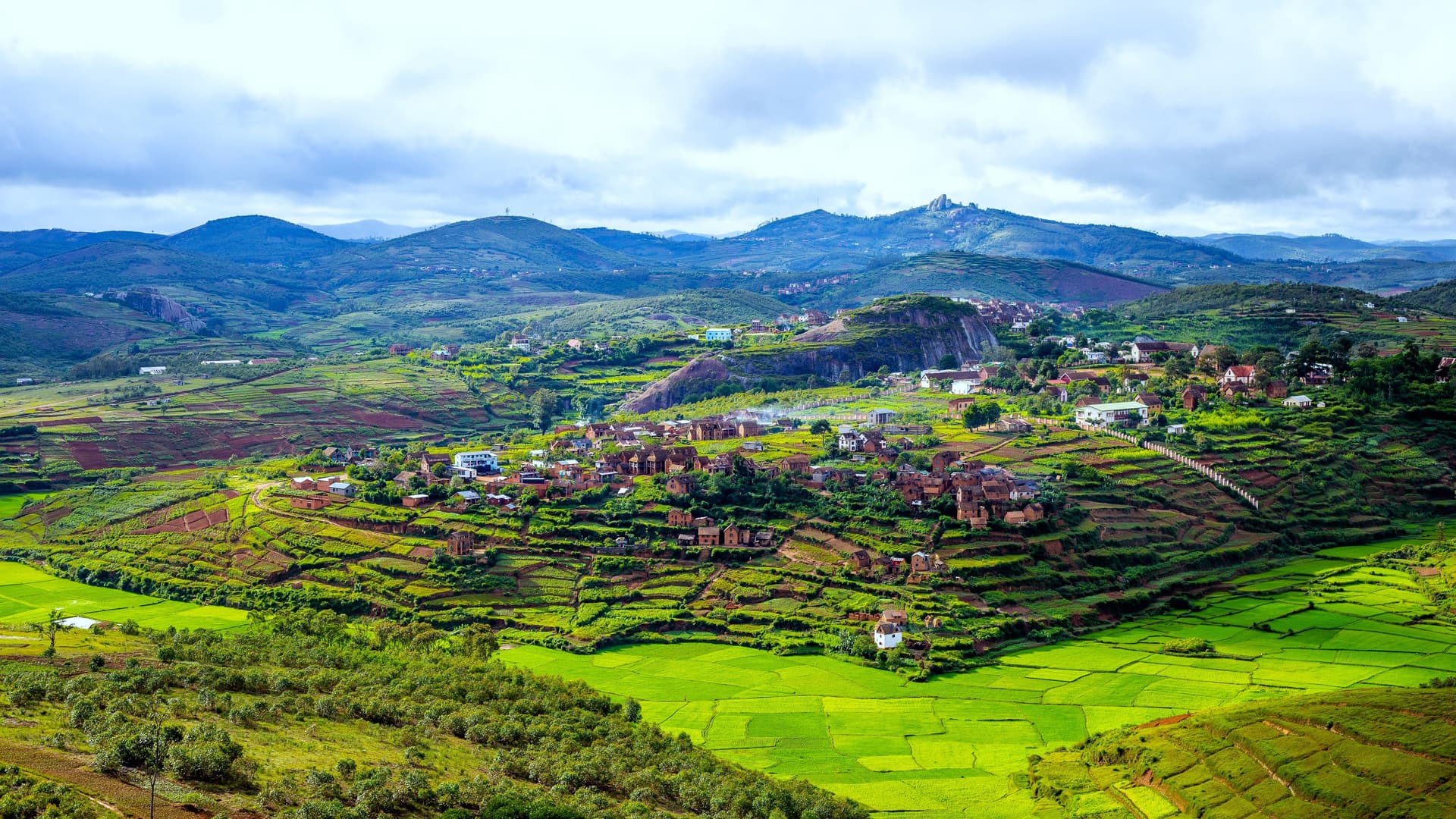
In central Madagascar between 1,200 and 1,500 metres, the Merina heartland aligns terraced rice paddies, red-brick villages and Zafimaniry artisan workshops.
The Central Highlands occupy Madagascar's interior on a granitic plateau reaching between 1,200 and 1,500 metres altitude. It is the island's most densely populated region and the historical heart of the Merina kingdom, unified in the early 19th century from the hilltop of Ambohimanga. Our English-speaking agency is based in Antananarivo, the capital, and most of our itineraries depart from here, allowing time to adjust to the time difference and acclimatise to the altitude before descending into the warmer regions of the South, West, or East Coast.
The landscape is immediately distinctive: terraced rice paddies hug every contour of the terrain, rounded hills support villages of red-brick houses two or three storeys tall, a legacy of Merina architecture codified in the 19th century. The rhythm of life follows the land. Rice planting in November-December, harvesting in April-May. Along the roads, you encounter oxcart convoys, carriers of fresh bricks, weekly markets where poultry, cassava and fabrics change hands. It is agricultural Madagascar, not beach resort Madagascar, and this contrast makes the journey toward the coasts so striking.
Antananarivo, which Malagasies simply call Tana, tiers its quarters across twelve hills. The upper city concentrates the Queen's Palace (Rova of Manjakamiadana), reconstructed after the 1995 fire, and the cobbled lanes around Lake Anosy. The lower city pulses with the Analakely market and Independence Avenue. Thirty kilometres north, Ambohimanga, UNESCO-listed in 2001, preserves the royal enclosure, sacred basins and the tombs of sovereigns. It is the founding site of Merina identity, still a living place of worship for Malagasy people.
Further south, the RN7 crosses Ambatolampy, renowned for its artisanal aluminium foundries where cauldrons are still cast in sand, then reaches Antsirabe 170 kilometres from Tana. A former spa town founded by Norwegian missionaries in 1872, Antsirabe retains its colourful pousse-pousse, workshops of semi-precious stones and miniatures carved from zebu horn. Beyond lies Ambositra, the capital of Zafimaniry craftsmanship, a sculpting people whose wood art has been inscribed in UNESCO's intangible heritage since 2008. The shutters, chests and honey boxes bear geometric motifs passed down through generations.
On the table, the Central Highlands have their own cuisine, more stewed and less spiced than coastal fare. Romazava, a broth of zebu meat with peppery greens that gently numb the tongue, is the national dish. Ranovola—the water from burnt rice served hot—is the beverage, and koba, cakes of rice, peanuts and banana cooked in leaves, are the sweet. Markets on Thursdays in Antsirabe and Saturdays in Ambositra reward visitors wanting to observe this peasant economy in motion.
The Central Highlands climate is temperate, which often surprises travellers expecting Madagascar to be uniformly tropical. July nights drop to 5°C, sometimes lower at higher elevations around Andringitra. A fleece and windbreaker are essential, especially when staying in Antsirabe or Fianarantsoa in the dry season. Rain concentrates from December to March, turning rice paddies into mirrors and making some secondary tracks challenging.
To discover
Ambohimanga royal hill. Twenty-four kilometres north of Tana, the dry-stone enclosure shelters the wooden palace of King Andrianampoinimerina and the sacred basins where sovereigns purified themselves. Allow a half-day including travel.
Zafimaniry workshop at Antoetra. A hilltop village one hour by track from Ambositra where sculptors work rosewood and palissander according to UNESCO-classified geometric codes. Day visits possible or overnight stays with local families.
Ambatolampy aluminium foundries. On the RN7, you enter workshops where cauldrons are cast in black sand at 700°C. The craft has not changed in fifty years and visits last about thirty minutes.
Silk workshops at Arivonimamo. Forty-five kilometres from Tana, follow the complete cycle of landibe wild silk: silkworm rearing on mulberry trees, spinning, hand-loom weaving, plant-based dyes from local leaves and bark.
Pousse-pousse and Lake Andraikiba at Antsirabe. The former spa town is best explored by pousse-pousse to reach Lake Andraikiba seven kilometres away, where women still wash laundry in the morning and where a legend of a drowned princess echoes by the water's edge.
When to go
The dry season from April to October is the most comfortable window for exploring the Central Highlands. Days reach 20 to 25°C, the sky remains clear and tracks are passable. In exchange, nights from June to August are genuinely cool: 5 to 10°C in Antananarivo and Antsirabe, sometimes 2°C at higher elevations. A fleece and windbreaker are essential, and a lightweight sleeping bag if you camp in Zafimaniry country. September and October are our preferred months: temperatures rising, jacarandas blooming around Tana, light still soft before the heat arrives.
From December to March, the rainy season brings daily showers, usually late afternoon, with monthly totals of 250 to 300 mm in January. Rice paddies turn emerald, but secondary tracks to Antoetra or Zafimaniry villages become muddy and some transfers take longer. Main roads (RN7, RN2) remain open. November is an interesting transitional period, with short early rains and rice planting beginning.
Practical advice
Two to three days suffice to grasp the spirit of the Central Highlands before heading south or west: one day in Tana and Ambohimanga, one day descending the RN7 to Antsirabe with a stop at Ambatolampy, one day pushing on to Ambositra and its Zafimaniry villages. For those interested in crafts, Merina history or agricultural landscape photography, a full week easily justified by adding Andasibe park to the east or the Ankaratra massif to the west. Ivato international airport, 20 kilometres north of Tana, is the entry point for nearly all our itineraries.
The region combines naturally with the South and RN7, which extends the descent toward Ranomafana, Isalo and Tuléar over 1,000 kilometres of tarmac. It also links with the East and Sainte-Marie via the RN2 toward Tamatave, and with the West and Tsingy via the RN4 then the track to Morondava. Comfort is reasonable along the main axis, with charming hotels in Tana, Antsirabe and Ambositra. The Central Highlands suit contemplative travellers, families with children (short stages, temperate climate) and those seeking to understand Madagascar before seeing its coastal extremes. It is not an intensive hiking region or centre for endemic wildlife: for that, you must venture toward Ranomafana or Andringitra.