The Malagasy Language
Before the 19th century and the translation of the Bible from English into Malagasy around 1820, Madagascar had no official writing system despite the existence of Antemoro manuscripts in Sorabe (pronounced sorabé), derived from Arabic, which dealt mainly with divination, occult sciences, and traditional pharmacopoeia.
Before the 19th century and the translation of the Bible from English into Malagasy around 1820, Madagascar had no official writing system despite the existence of Antemoro manuscripts in Sorabe (pronounced sorabé), derived from Arabic, which dealt mainly with divination, occult sciences, and traditional pharmacopoeia. The country's history, customs, and traditions were transmitted orally from generation to generation through what is known as the "oral tradition" or "lovan-tsofina" (literally "heritage of the ear").
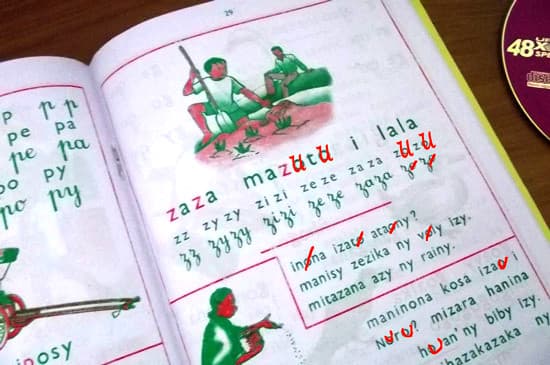
Education took place through games, stories, and legends. The Bible thus became the first book written in Malagasy. The alphabet is the Western alphabet but composed of only 21 letters instead of 26. The letters c, q, u, x, and w do not exist in the Malagasy language.
The verb "to be" does not exist in Malagasy. The sentence structure in Malagasy is Verb + Complement + Subject (unlike English: Subject + Verb + Complement).
- Example: Mihinana vary aho: I eat rice. Verb: mihinana (eat) Complement: vary (rice) Subject: Aho (I)
A few tips for speaking Malagasy well:
- The letter "o" is pronounced "oo"
- The letter "s" is always sibilant
- The letter "e" is pronounced "ay"
- The letter "g" is pronounced "gue" before all vowels
- Final vowels are silent or barely aspirated (less accented). Ex: omby (ox or zebu) is pronounced oombe, with "o" sounding like "oo" and the final "y" being silent.
- A few words in Malagasy -
- Good morning/afternoon/evening Madam, Sir, how are you?: manao ahoana Tompoko? (manaou ahouane toumpouk)
- I'm fine, thank you: tsara fa misaotra (tsara fa misaoutr toumpouk), or salama tsara
- Goodbye Madam, Sir: veloma Tompoko (veloum toumpouk)
- Welcome: tonga soa (tounga sou)
- Have a good trip: soava dia (souava di)
- Thank you: misaotra
- Yes: eny, eka
- No: tsia
- Good, well: tsara
- Bad, wrong: ratsy
- Excuse me: azafady
- How much: firy
- How much does it cost?: Ohatrinona?
- Where?: aiza?
- Where are you going?: Ho aiza?
- Where are you from?: Avy aiza ianao?
- Where are you going?: Ho aiza ianao?
- Far: lavitra
- Near: akaiky
- Money: vola
- Rice: vary
- Bread: mofo
- Meat: hena
- Water: rano
- Alcoholic drink: toaka
- To eat: mihinana
- To drink: misotro, migaka (dialect)
- To be thirsty: mangetaheta
- To be hungry: noana (nouana), mosary (dialect)
- Yesterday: omaly
- Tomorrow: rahampitso
- Today: anio (said in the morning), androany (said in the evening), ankehitriny (at present)
- To be hot: mafàna
- To be cold: mangatsiaka, manintsy (dialect)
- Animal: Biby
- Chicken, poultry: akoho
- Chick: zanak'akoho
- Rooster: akoholahy
- Lemur: gidro
- Dog: alika, amboa (dialect)
- Cat: saka
- Horse: soavaly