The Essentials of the West and the Tsingy of Bemaraha
From the limestone blades of the Tsingy de Bemaraha to the great rivers of Menabe, eight days in the heart of western Madagascar.
Duration
8 days
From
€1,010/pers.
Ideal seasons
Apr, May, Jun, Jul, Aug, Sep, Oct
Style
Guided tour
Comfort
classique
Travelers
Couple, Solo, With friends
The spirit of travel
This eight-day module opens the doors to western Madagascar, a country of sedimentary plains, wide rivers and dry forests, dominated by the great limestone plateau of Bemaraha. After a first night in Antananarivo and a flight to Morondava, on the coast of the Mozambique Channel, we head north along the Menabe tracks, amid baobabs, crossing the Tsiribihina by ferry then the Manambolo.
In Bekopaka, three nights give us time to discover the Tsingy de Bemaraha, inscribed on the UNESCO World Heritage List. By pirogue in the Manambolo gorges, then on foot in the Petit and Grand Tsingy, we travel through a labyrinth of limestone blades, canyons and caves shaped by water for millions of years, where Decken's sifakas live.
The return is by road: the coastal plain, the Bongolava escarpment, then the volcanic Highlands of Vakinankaratra to Antsirabe and Antananarivo. In one day, we cross the entire geological cross-section of the western part of the island.
This module combines with the other regional modules of Détours Madagascar: South, North and East. Each departs from Antananarivo and returns there, which allows you to create a tailor-made trip of two, three or four weeks by linking them together.
The stages of your journey
Highlights
Day-by-day itinerary

Arrival in Antananarivo
Upon arrival at Ivato international airport, a member of the Détours Madagascar team welcomes us and takes us to our hotel in Antananarivo. The transfer takes approximately 45 minutes.
Depending on our flight time, we discover the first faces of the capital on the way. The city is built on a dozen hills, in the midst of the rice fields of the Betsimitatatra plain. Two-storey brick houses with wooden balconies cluster on the slopes, and long staircases connect the upper neighborhoods to the markets of the lower city.
Antananarivo was founded in the 17th century on the highest of these hills, around the palace of the Merina sovereigns. Today it is a lively capital, where life largely takes place in the street: street vendors, minibuses, rickshaws and carts share the road.
This first evening, we take time to settle in and rest from the journey. Our team answers our last questions about the course of the trip, which takes us from tomorrow towards the West, the rivers of Menabe and the Tsingy of Bemaraha. Dinner is not included.

Flight from Antananarivo to Morondava
According to the flight schedule, we head to Antananarivo airport for the flight to Morondava. Transfer from the hotel to the airport early in the morning.
The flight lasts approximately one hour. From the window, the geography of the island reads like a cross-section: the laterite hills of the Highlands, red and carved by lavaka, give way to the tabular reliefs of the West, then to the great sedimentary plain crossed by silt-laden rivers that wind towards the Mozambique Channel.
Upon arrival in Morondava, our team welcomes us at the airport and takes us to the hotel.
Morondava stretches out on a sand strip between the Mozambique Channel and the mangrove waterways of the Morondava delta. The landscape flattens out: we are in the heart of the Western sedimentary basin, an immense plain made of sands, clays and limestones torn from the Highlands and deposited here for tens of millions of years. The sea nibbles away at this fragile shoreline and the city lives to the rhythm of this coastal retreat.
The rest of the day is free. The beach invites you to walk, to the rhythm of the fishermen's outrigger canoes that sail back in late afternoon. These boats carved from a single tree trunk, rigged with a square sail, belong to the Vezo, a seafaring people who live from fishing along the entire west coast. Their villages are on the other side of the channel, just a few minutes by canoe away.
Morondava is also the capital of Menabe, a former Sakalava kingdom. The Sakalava held this coast and its hinterland for centuries. The market, very lively in the morning, brings together the products of the plain: rice, cassava, dried fish, lima beans, spices.
At sunset, the slanting light sets the sea and the silhouettes of the pirogues ablaze. It is our first evening in the West, a land of vast horizons, dry heat and wide rivers, which we will explore until we reach the Tsingy de Bemaraha.

From Baobabs to Tsingy de Bemaraha
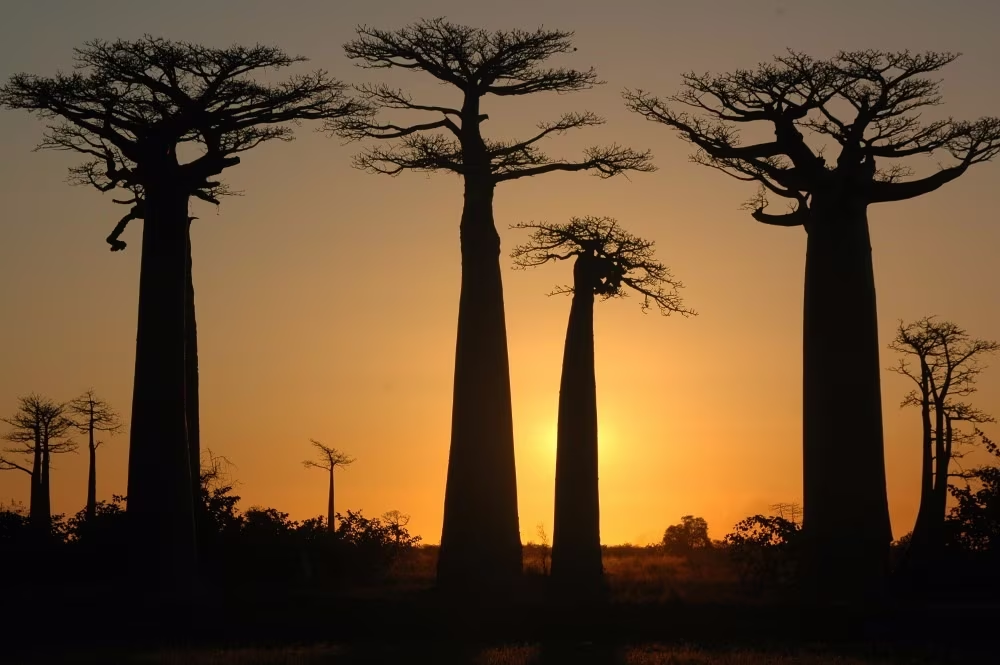
Early morning departure heading north in a four-wheel drive vehicle for a long day on the trail, covering approximately 200 km. As soon as we leave Morondava, the plain becomes covered with baobabs. Three of the six endemic species of Madagascar grow in the Menabe region, including the most majestic, Adansonia grandidieri, with its smooth, reddish trunk rising in a column up to nearly thirty meters high. These trees are witnesses to the dry forest that once covered the plain and has since been pushed back by rice paddies and pastures.
The sand and laterite track then crosses fragments of dry forest, savannas dotted with palm trees and Sakalava villages, with their granaries on stilts and herds of zebu cattle. By late morning, we reach the banks of the Tsiribihina River. This great river, originating in the Highlands, carries red sediments torn from the hills towards the sea. The ferry takes us across to Belo-sur-Tsiribihina, a small town where we stop for lunch.
In the afternoon, the track heads north. To the east, the line of the Bemaraha plateau gradually appears, a high limestone wall that dominates the plain for over a hundred kilometers. We reach the Manambolo River, which has carved a spectacular gorge through this plateau before emerging into the plain. A second ferry takes us to Bekopaka, at the foot of the cliffs.
Arrival in the late afternoon and hotel check-in. It is a long day, the track is demanding, and each river crossing punctuates the journey. Depending on the season and the state of the track, our driver adjusts the schedule and stops accordingly.

Pirogue on the Manambolo and Hiking in the Tsingy
The Bemaraha plateau is made of limestone from the Middle Jurassic, deposited approximately 160 million years ago at the bottom of a warm, shallow sea. Uplifted, fractured, and then attacked by rains for millions of years, this limestone dissolved along the cracks. What remains is a forest of mineral blades and needles separated by narrow corridors and canyons: the tsingy. The Malagasy word designates a place where it is impossible to walk barefoot.
The morning begins on the water. In a pirogue, we descend the Manambolo at the foot of the cliffs that frame the gorge. The river has opened a breach in the plateau, and the rock reveals its layers, overhangs, and caves. Some cavities served as burial sites for the Vazimba, the first inhabitants of the region according to tradition, and remain respected places. We dock to visit a cave with concretions, before heading back towards Bekopaka.
Then we enter the Petit Tsingy, near the village. The trail winds between the blocks, passes under arches, crosses footbridges and ladders. At the bottom of the fissures, humidity sustains dense vegetation, while the sun-scorched peaks host only plants adapted to dryness: pachypodiums with swollen trunks, euphorbias, figs with roots clinging to the rock. This juxtaposition of environments over just a few meters accounts for the richness of the park, inscribed as a UNESCO World Heritage site in 1990.
The fauna is discreet but present. It is common to encounter Decken's sifakas, with white fur, which bounce from block to block, as well as brown lemurs. The birds of the dry forest, couas and vangas, are often heard before being seen. Picnic lunch, then return to the hotel at the end of the day.

Hiking in the Grand Tsingy of Bemaraha
Day dedicated to the Grand Tsingy. A 4x4 transfer of approximately 17 km northward takes us to the start of the trails. Here, the plateau reveals its full scale: limestone cathedrals dozens of meters high, networks of deep fissures, sharp needles aligned like blades.
The route alternates between hiking, narrow passages and small climbs. Equipped with a harness and lanyard, we progress along sections fitted with cables, ladders and walkways. The trail descends to the bottom of the diaclases, these vertical fissures where light barely penetrates, then rises back up to the ridges. At the summit, a suspension bridge spans a canyon and opens the view onto the immensity of the plateau, a sea of grey peaks extending to the horizon.
This landscape tells a slow story. Rainwater, slightly acidic, dissolves the limestone along the fractures. The fissures widen into corridors, the corridors into canyons, and the blocks that remain standing sharpen into blades. Beneath the plateau, a network of caves and underground rivers continues this work. The Bemaraha forms one of Madagascar's largest karst complexes.
The hike requires good physical fitness and an absence of vertigo. The park's local guide accompanies us and sets the pace. Picnic lunch along the route, then return to Bekopaka at the end of the day.

Return to the Kingdom of Baobabs
Early morning departure for the return to Morondava. The ferry across the Manambolo, at the foot of the cliffs, opens the day. In the morning light, the escarpment of Bemaraha takes on grey and golden hues, and as we leave it, we measure the power of this limestone plateau rising above the plain.
The track descends south again through savanna and dry forest. Villages succeed one another: houses of earth and plant materials, granaries on stilts, zebu enclosures. In Menabe, the zebu remains the measure of wealth and the heart of the social and ritual life of the Sakalava. In the low-lying lands, flooded during the rainy season, rice paddies occupy every plot.
We reach Belo-sur-Tsiribihina around midday and have lunch there. The ferry then takes us across the Tsiribihina. This crossing, with its pirogues, its carts, its travellers and goods, shows how much the river structures the life of the region: it serves as a road, as a reserve of fish and water for crops.
In the afternoon, the plain is again covered with baobabs. Just before Morondava, the track takes the Avenue of the Baobabs, an alignment of large Adansonia grandidieri at the edge of the rice paddies. At the end of the day, the slanting light colours their trunks ochre and pink. Arrival in Morondava in the evening and check-in at the hotel.

Antsirabe, the City of Water
A long day of driving, approximately 480 km, climbing from the coastal plain to the Highlands. The journey crosses in one day the great geological divide of the western part of the island, from the recent sediments of the coast to the ancient crystalline bedrock of the center.
Leaving Morondava, the road runs through the rice fields of the plain, then reaches Mahabo and Malaimbandy. The landscape becomes drier: grass savannas, sparse trees, tabular reliefs carved by erosion. We reach Miandrivazo, on the banks of the Mahajilo, known as one of the hottest cities in Madagascar. It is also the departure point for pirogue descents on the Tsiribihina.
After Miandrivazo, the road climbs the escarpment of the Highlands. The bare mountains of Bongolava, ravaged by erosion, mark the boundary between the sedimentary West and the bedrock. The lavaka, large cirque-shaped cuts carved into laterite soils, tear through the hillsides. As we climb, the air cools and terraced rice fields reappear at the bottom of the valleys.
In the region of Betafo and Antsirabe, the landscape changes again: we enter the Vakinankaratra, a volcanic country with cones and crater lakes, whose fertile soils bear a patchwork of rice fields and vegetable crops. The two-storey red brick houses, typical of the Highlands, multiply. Stops in the markets of the villages we pass through punctuate the route. Arrival in Antsirabe at the end of the day.

Return to Antananarivo and Departure
Antsirabe, "where there is a lot of salt", developed at the end of the 19th century around its thermal springs, linked to the volcanic activity of Vakinankaratra. This water town has retained from that era wide avenues, old buildings and a railway station. It is also the capital of the rickshaw, which remains the most common means of transport in its streets.
In the morning, we take time for a tour of the city. Antsirabe lives from craftsmanship: zebu horn work, embroidery, recycled objects. Depending on available time, our driver shows us a few workshops.
Then we head to Antananarivo via RN7, approximately 170 km. The road crosses the heart of the Highlands, between 1,300 and 1,600 meters altitude. Red laterite hills, terraced rice paddies that follow each valley, villages of brick houses and family tombs along the fields make up the landscape. Crops change with altitude and season: rice, corn, potatoes, fruit trees.
Arrival in Antananarivo in the afternoon. Depending on our international flight schedule, transfer to Ivato airport. This module of the West ends here. It can also be extended with one of the other regional modules of Détours Madagascar (South, North or East), all of which depart from the capital.
Price per person
Indicative price per person, based on double room. Each trip is customized according to your preferences.
This trip can be tailored to your preferences
This itinerary provides an excellent foundation for discovery, but it can be fully customized. Our local advisors build each trip tailored to your budget, dates and preferences.
Not included
- International flights
- The domestic flight Antananarivo - Morondava (on Day 2)
- All meals except breakfast and picnics on days 4 and 5
- Activities not mentioned in the programme
- Single room supplement (€290 per person)
- Tips, drinks and personal expenses
- Cancellation insurance, repatriation and first aid expenses
- Visa fees
Included
- Accompaniment by English-speaking driver-guide(s)
- Transport in a 4x4 vehicle (maximum 4 travelers per 4x4 vehicle)
- Accommodation in double/twin room in the hotels mentioned in the program with breakfast
- Picnic lunches for days 4 and 5
- Entrance fees at the indicated sites
- Local guides in parks and reserves
- All transfers
Practical Information
Registration is considered firm and final after payment of a deposit of 40% of the total price and acceptance of the specific terms of sale.
The balance must be paid no later than 45 days before the departure date.
See our specific terms of sale for full details.
In the event of cancellation by the traveller, the following fees apply:
More than 60 days before departure: 40% of the total price (deposit retained)
Between 60 and 30 days before departure: 50% of the total price
Less than 30 days before departure: 100% of the total price
We strongly recommend taking out cancellation insurance. See our specific terms of sale for full details.
Your Passport:
Important: your passport must be valid. It must be absolutely and obligatorily valid for 6 months after the end of your stay in Madagascar.
Your travel documents
Your valid passport,
Your international and/or domestic flight tickets,
Your repatriation and emergency care insurance contract,
Your vaccination record if applicable,
Your blood type card if possible.
Obtaining a visa to enter Madagascar
Upon arrival in the territory:
Since February 16, 2026, the visa costs €30 for up to 15 days, €35 for 16 to 30 days, €40 for 31 to 60 days and €50 for 61 to 90 days. It can also be requested online before departure on the official e-visa portal (evisamada.gov.mg). An additional tourist tax of €10 is paid in cash upon arrival.
It is easily obtained upon your arrival in Madagascar.
This applies to all airports in Madagascar that handle international flights.
Upon arrival at the airport terminal, upon exiting the plane, a corridor for passengers is dedicated to issuing tourist visas.
This procedure is the simplest. We recommend it to you.
At the embassies and consulates of your home countries:
For information, download the document explaining the procedure and the file requirements for obtaining a visa from the Embassy of Madagascar.
To participate in our trips, it is strongly recommended to be insured for repatriation assistance and medical expenses abroad.
Your local agency encourages you to familiarize yourself with the specific contract developed with our partner CHAPKA ASSURANCES and AXA ASSISTANCE.
To subscribe to insurance, learn about coverage and rates, follow the link below.
CAP EXPLORER: The comprehensive insurance solution designed to enjoy your trip with peace of mind!
Choose the plan that best suits you:
Explorer'Multirisque
Explorer'Annulation
Explorer'Assistance
Specific to our trips, we strongly recommend subscribing to them.
If you choose to subscribe to one of these plans, the policy detailing all coverage and procedures for claiming any loss are available on the insurer's website.
Your local agency will be aware of it, but only the participant is responsible for complying with the procedures for declaring any loss. The participant must therefore keep this policy with them throughout their trip.
Chapka — Cap Explorer
Our insurance partnerTravel with peace of mind with our partner Chapka. Cancellation, repatriation, medical expenses, baggage… All the coverage for a worry-free trip.
Travel with peace of mind — I'll handle the insuranceFrequently asked questions
A tourist visa is required, issued upon arrival at Ivato Airport (Antananarivo) or online (e-visa). Your passport must be valid for at least 6 months from your date of entry. Before booking your trip, check with Madagascar's consular authorities for the conditions applicable to your nationality, including visa fees and authorized lengths of stay.
Go to the My Trips section to find all your projects.
You can send a message to your host directly from the Tea Lounge.
For a tailor-made quality trip, expect between 160 and 270 euros per day and per person, including accommodation, meals, internal transfers and English-speaking guide. International flights (900-1400 euros return) are additional. Long transfers and domestic flights represent a significant portion of the budget.
Your documents are accessible in the Documents tab of your trip.
Absolutely. We adapt each itinerary to suit your travel profile. For families, we prioritize relaxed pacing, family-friendly accommodations, fun and educational activities, and comfortable private transfers. Our local English-speaking guides know how to captivate children with age-appropriate anecdotes.
It's simple. You exchange with our local team to define your wishes, budget and dates. You receive a detailed itinerary proposal within 48 hours. You adjust every detail together until it's perfect. You confirm and travel with peace of mind. Your local agency remains available 7 days a week throughout your trip.
In case of emergency, contact your local agency immediately.
Payment is generally made in two installments.
Our agency is part of the Nomadays network, registered in France. You benefit from APST (Association Professionnelle de Solidarité du Tourisme) protection, which covers 100% of your funds. Secure payment, professional insurance, and English-speaking assistance 7 days a week on the ground throughout your stay. Travel insurance (assistance and repatriation, cancellation) is not included: we offer it through our insurance partner and strongly recommend it.
Let's talk about your adventure — Wild West
Ambassador of Malagasy fihavanana, based in Antananarivo
For me, traveling to Madagascar is stepping into the spirit of fihavanana: sharing, helping one another, meeting people, and taking time to understand what connects them to their land.
— Noro