Madagascar's Highlands
Madagascar's Highlands extend southward where verdant hills and undulating rice terraces gradually give way to the arid landscapes of the Grand South. Here, thanks to its altitude, the climate is temperate and ideal for trekking adventures.
The Highlands of Madagascar stretch southward where verdant hills and undulating rice terraces gradually surrender to the arid landscapes of the Grand South. Here, thanks to its altitude, the climate is temperate and conducive to exploration on foot. December, January and February are months to avoid—cyclone season—but outside this window, travelers can confidently embark on an adventurous journey blessed by favorable weather.
Highland Towns
Antananarivo, the capital, the "City of a Thousand", has drawn its identity from a harmony of contrasts; sleek glass buildings mingle with the grandeur of royal palaces and gritty neighborhoods. You must visit to explore Analakely Bazaar, perpetually alive with color and flavor, and wander through Tsimbazaza Zoo. Then venture toward the Upper Town, perched at the summit between steep slopes and commanding a majestic presence over tiled rooftops and eternally flower-bedecked balconies. This fortified quarter houses the Manjakamiadana Palace, revered by historians as the finest expression of Malagasy architecture. (Worth noting: the palace bears an imprecise name; the kingdom's rulers included far more kings than queens, the latter ascending the throne only in the monarchy's twilight). The Upper Town is merely the gateway to a cultural circuit threading through the twelve sacred hills of Imerina: Alasora Hill, Ambohitrabiby Hill, Ambohidratrimo Hill, Ambohimanga Hill, Analamanga Hill, Antsahadinta Hill, Ikaloy Hill, Ilafy Hill, Imerimanjaka Hill, Imerimandroso Hill, Ambohijoky Hill and Namehana Hill. The undisputed highlight is Ambohimanga, the royal hill (the Blue City), early inscribed on UNESCO's World Heritage list. Seized by force in 1897 by Prince Ramboasalama, this hill once hosted the political and religious capital of the Kingdom of Madagascar, the first kingdom formally recognized by Europeans.
A different sort of excursion awaits at Antsirabe, nicknamed the City of Waters for its abundance of hot springs and often considered Madagascar's most charming town. Amid tobacco plantations, volcanic landscapes, emerald-hued lakes and the forest labyrinth of Ranomafana Park, Antsirabe is an inexhaustible playground for trekking enthusiasts. Other trekking destinations include Lake Alaotra, Lake Mantasoa and Ampefy, a volcanic region crisscrossed by marshes, waterfalls and impressive geysers. Your discovery of Madagascar's Central Highlands remains incomplete without a stop in Fianarantsoa, "the City Where One Learns Good". This is Betsileo country—land of terraced rice paddies, centuries-old vineyards and skilled artisans.
Highland Encounters
Exploring the Highlands is also about forming friendships with local communities and falling under the spell of their cultural traditions. They possess a distinctive heritage that the Merina and Betsileo peoples inherited from Southeast Asia. Among Malagasy sources of pride is the concept of "fihavanana": everyone respects one another as members of a single family; you will never hear villagers quarrel, raise their voices or hurl insults in public, for they attach profound importance to harmony. This "fihavanana" manifests itself in a legendary sense of hospitality. Upon arriving in a village, tourists are invited to share a rice meal with farmers. The most authentic recipe is "vary sosoa"—served in the evening: a rice broth accompanied by zebu skewers. "Fanorona", a chess-like game woven into Malagasy culture, is well worth discovering. A bespoke journey through the Highlands can include performances of folk songs and dances. Yet the most defining trait of Merina and Betsileo civilization lies in the veneration of ancestors. According to their beliefs, the relationship between the living and the deceased continues beyond death. Another facet of "fihavanana", some would say. This gives rise to animist practices that sometimes trouble devout Christians, yet most Malagasies still feel morally bound to perpetuate them.
Trekking in the Highlands
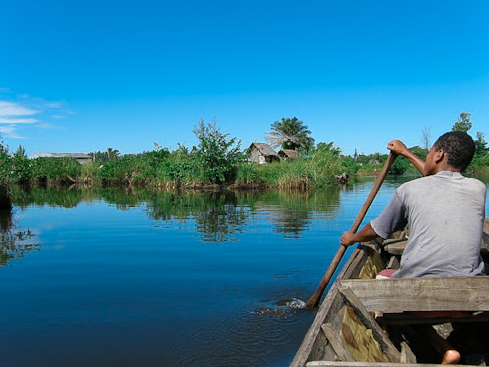
Hiking through spectacular, little-known mountain landscapes is an excellent way to discover and immerse yourself in the rural and cultural life of the Central Highlands communities. Agriculture, cattle raising and fishing sustain most of the working population. The Tsaratanàna Massif in the north, crowned by the island's highest peak, Mount Maromokotra at 2,876 meters, is shrouded in dense forest. It sees few visitors due to difficult access. An old poem captures the beauty of these ranges:
"O mountain chain stretching to the horizon,
Lovingly shaded and grassy,
Barely does the eye wander there, a guileless blink,
Your heights transmit a contagious nostalgia,
A liar claims not to yield to such sighs,
For he longs to return from exile and prepares to depart".
These lines were composed by a committed twentieth-century poet, exiled to the Comoros for leading revolts against French colonial rule. Like him, travelers experience that tightness of heart when leaving the soaring mountains of central Madagascar, where a gracious and welcoming people dwell—people to whom one grows attached, knowing departure is inevitable. A journey from which you return with a heavy heart and memories that will never fade…