Violette and Dieudonné's Ironwork Studio: A Social Enterprise
Violette and Dieudonné's ironwork studio is a genuine model of social entrepreneurship, managing a self-sufficient village of artisans. The husband is the artist and craftsman, while the wife
Violette and Dieudonné's ironwork studio is a genuine model of social entrepreneurship, managing a self-sufficient village of artisans. The husband is the artist and craftsman, while the wife is the master of the place, the shop manager, even participating in international fairs in Europe. What this couple has managed to build is a model to follow in terms of sustainable development in Madagascar.
Workshops on a one-hectare plot
The company's beginnings
Dieudonné Razafinjatovo was originally a physical education teacher. His father was a blacksmith, specializing in sheet metal work, the fabrication of objects made from sheet white metal. Wanting to change his life, Dieudonné turned to ironwork to perpetuate his father's expertise and went further by pursuing training in design and creation. He then obtained a scholarship to Paris in 1996, allowing him to learn superior foundry techniques compared to those traditionally used by Malagasy artisans.
The best of contemporary Malagasy craftsmanship
Oil and diesel barrels, as well as recycled sheet metal, are used to manufacture everyday objects themed around Malagasy culture, fauna and flora. Lampshades, furniture of all kinds, decorative baobabs, wall sconces, wrought iron lamps and trays, animal sculptures, and more are displayed and offered in the ironwork shop. The distinctive feature of these objects is their "aged metal" finish: the rust-toned iron is coated with wax.
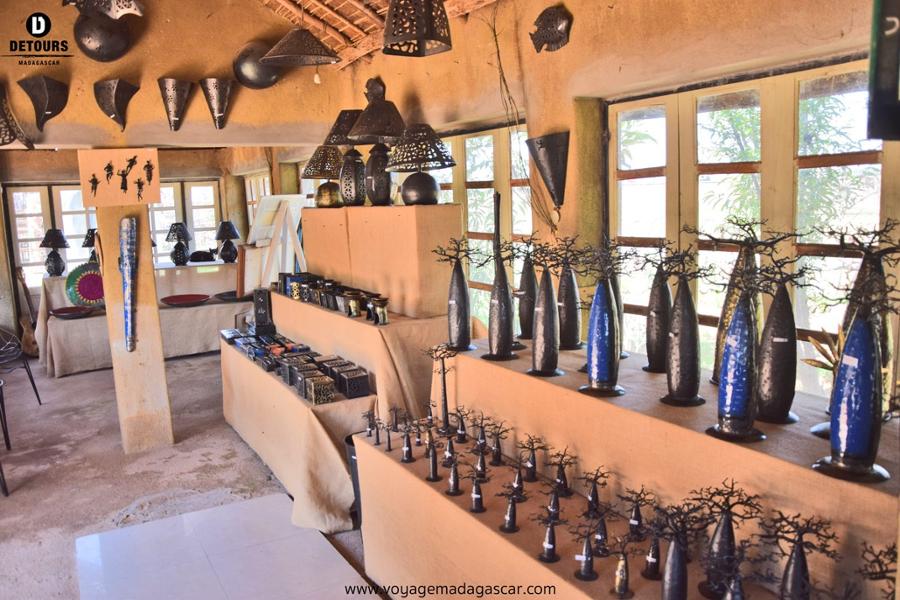
An ironwork studio unlike any other
When success came, Dieudonné and his wife, Violette Ralalaseheno, a former elite athlete, decided to expand their business by hiring artisans. Their goal being to help others and improve social conditions, they appeal to people on the margins of society, notably the visually impaired, people with Down syndrome, those with physical disabilities, the homeless, former inmates… The workshops today occupy a one-hectare plot in Ankazobe-Mandroseza (15 km from downtown Antananarivo), including a shop, two schools, cultivated land, fish ponds, and more.
It has also become a family business, as the couple's children each have their own place in the company. Fitiavana Ratovo is an artist who creates wrought iron sculptures on commission or for exhibitions. He notably displayed several sculptures last March on the theme of "hidden beings" at the Is'Art Gallery. Finona, for her part, manages the shop and international fairs.

Knight and horse in wrought iron created by Fitiavana for a military camp
A solidarity community
A village of blacksmiths
Violette and Dieudonné did not theorize their social entrepreneurship, but simply followed their hearts. The workshops operate as a cooperative of nearly 120 families, counting some 350 people in total. The profits obtained are used for food, educating children, growing organic vegetables and fruits for the community, and so on. The ecovillage already produces 30% of its food through organic agriculture (using vermicompost among other methods) and fish farming.
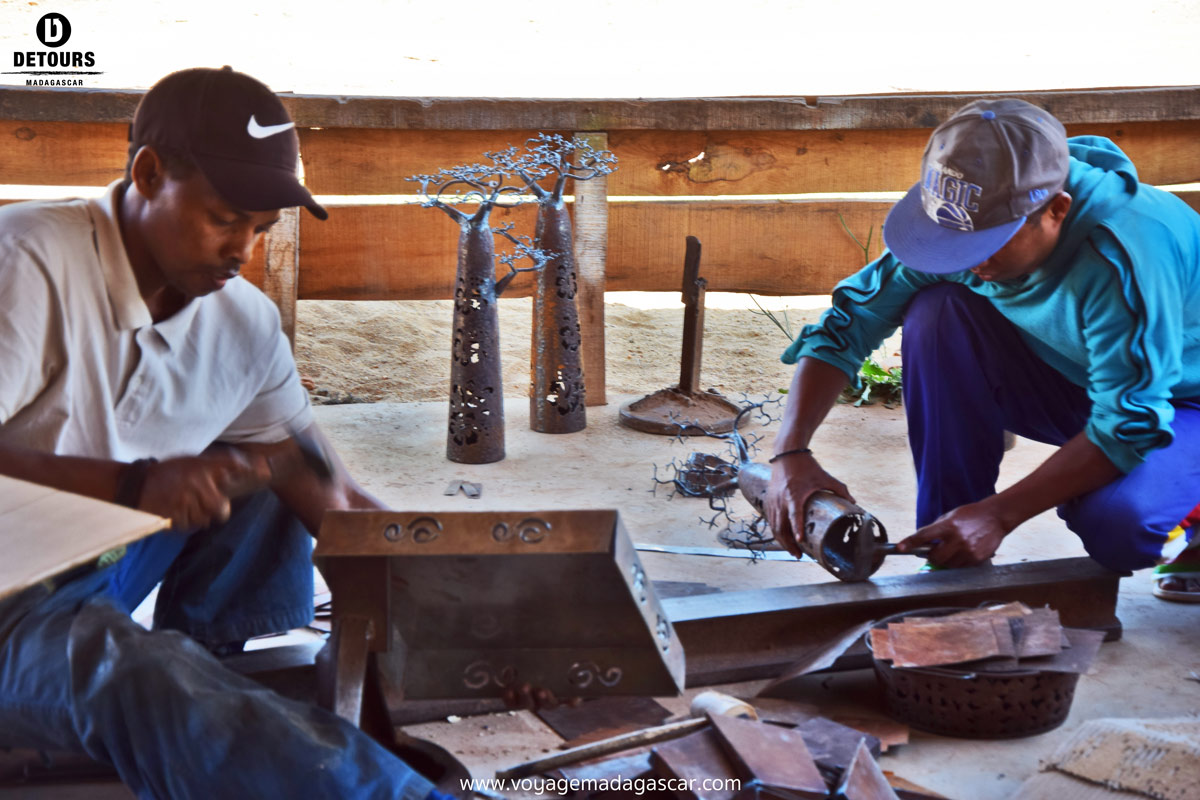
Malagasy artisans manufacturing decorative baobabs
A school for the artisans' children
The ironwork village has a solidarity school for the blacksmiths' children: the 4FA. The structure was initially organized as an association, then became a solidarity school. It should be noted that schooling for children is expensive in Madagascar and modest families do not have access to it. Since 2005, this school has enabled the artisans' children to reach the Brevet d'Étude du Premier Cycle (lower secondary education).
Upcoming solidarity projects
Violette and Dieudonné are also planning the development of after-school activities for the artisans' children: sewing, visual arts and pottery workshops, theater… Dieudonné also wishes to learn wheat cultivation. Many remain the challenges the couple still wishes to tackle to improve their community…
©Détours Madagascar - 22 October 2018