How, When and Where to See Whale Sharks in Madagascar?
Have you always dreamed of seeing whale sharks or better yet, swimming alongside them? Your dream can become reality in Madagascar. The waters surrounding the country constitute an important
Have you always dreamed of seeing whale sharks or better yet, swimming alongside them? Your dream can become reality in Madagascar. The waters surrounding the country constitute an important migration zone for this creature as impressive as it is harmless.
Whether you're diving, snorkeling or freediving, an encounter with the world's largest fish promises moments filled with emotion. But how do you go about it, where to go and when? Discover our practical guide to seeing whale sharks in Madagascar.
Why is Madagascar a top destination for seeing whale sharks?
Madagascar is among the world's best destinations for seeing whale sharks. The reason? Every year, they return to the tropical waters of the channel surrounding Africa's largest island to feed. And for good reason: the waters in the region of the Mozambique Channel are renowned for being particularly rich in their favorite food: plankton, algae, small fish (such as sardines, anchovies, mackerel, juvenile tuna), small crustaceans and squid.
In short, Madagascar's waters provide an excellent larder for whale sharks, which return to them every year at the same time and for a few months.
Did you know?
Scientists have noted that most whale sharks observed around Madagascar are juvenile males. These must consume 21 kg of plankton daily to survive and grow. This is why they return to the waters in the region, which are rich in plankton.
It is known that females migrate over shorter distances, but there is still much to discover about their behavior. As explained by Nausicaà: "Whale shark reproduction is poorly understood: we don't know where they mate or where females give birth".
How to recognize whale sharks?
The whale shark (Rhincodon typus) is a species of cartilaginous fish, the sole member of the genus Rhincodon and the sole extant species in the family Rhincodontidae. Capable of reaching 15 m in length (or even 20 m for some individuals), it is considered the world's largest fish.
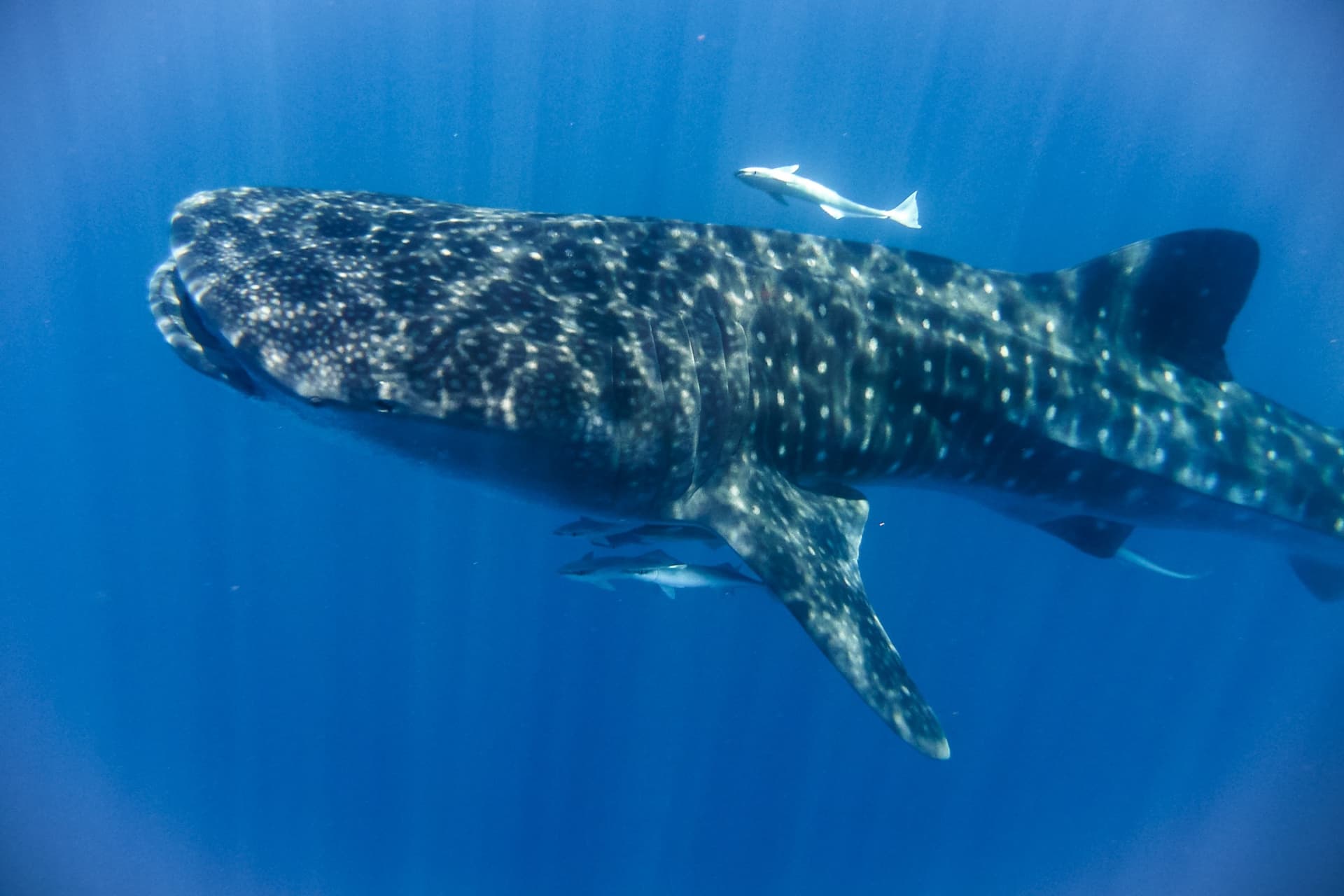
The whale shark is easily recognizable. It has a massive body and a flat head with a large mouth (measuring up to 2 m in width), 2 triangular-shaped dorsal fins and 2 pectoral fins. It has 5 vertical gill slits above its pectoral fins that serve to breathe and filter the water it absorbs to feed. The animal filters an average of more than 600,000 liters of water per hour!
In Malagasy, the whale shark is known by the name "marokintana," which can be translated as "the shark with a thousand stars." And for good reason—it is characterized on its back by gray-blue coloring scattered with white spots and lines, all forming a checkerboard pattern. This characteristic allows scientists to identify them since each pattern is unique.
Another distinctive feature of the whale shark: it has particularly thick skin that constitutes its primary means of defense. This can reach 15 cm in thickness—the thickest skin in the entire animal kingdom.
Finally, it should be noted that whale sharks are excellent "breath-holders." Indeed, recent studies have shown they can remain submerged for several months at a time, returning to the surface only to feed. They can dive to depths of more than 2000 m and live for over 130 years!
Is the whale shark an endangered species?
Unfortunately, the whale shark has been classified as an endangered species on the IUCN Red List of Threatened Species since 2016. The reasons for the decline in populations?
- Plastic pollution,
- Ocean warming,
- Overfishing (causing loss of their food sources),
- Accidental catches caused by tuna fishing vessels,
- Collision accidents with boats (On the island of Nosy Be, 40% of identified whale sharks bear scarring from boat propellers)...
Where to see whale sharks in Madagascar?
The whale sharks migrating to Madagascar always visit the same places, namely:
Nosy Be
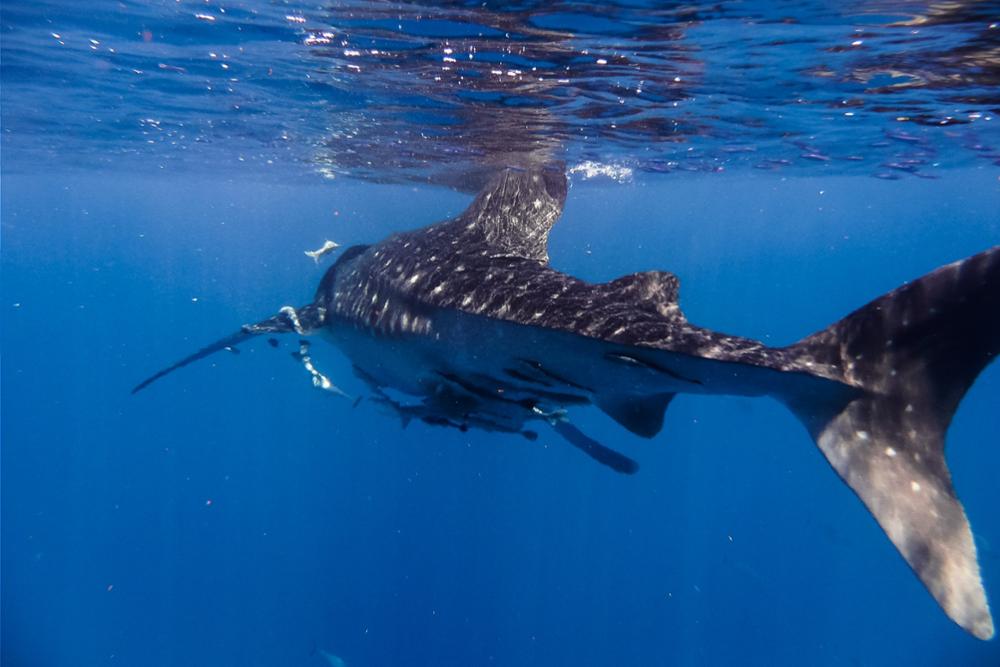
If we had to highlight just one location, it would be the island of Nosy Be, a volcanic island located in the northwest of the country known as the best spot for observing whale sharks in Madagascar. According to a study conducted by the Madagascar Whale Shark Project, Nosy Be is even considered a hotspot of global importance for juvenile whale sharks.
The fragrant island is among the best places to dive in Madagascar. But for those who want to see whale sharks without having to opt for scuba diving, you can always choose a snorkeling excursion to swim alongside them.
Other spots to see whale sharks in Madagascar
Besides Nosy Be, whale sharks can be spotted at other locations in Madagascar. This includes the coastline of Tuléar. Indeed, the waters of southwestern Madagascar's coast are home to an immense coral reef massif nearly 300 kilometers long that constitutes the ideal refuge for marine fauna. Thus, it is not uncommon to encounter whale sharks there.
Whale sharks can also be observed in the waters of Sainte-Marie Island (Nosy Boraha), a small island located off the coast of eastern Madagascar. Here, shallow and protected waters form a privileged environment for pelagic species. The island is also known for its wrecks and for being one of the world's best places to see humpback whales.
Are you interested in cetaceans and marine creatures? Madagascar's waters are not only home to whale sharks—they also contain other species such as:
- The humpback whale,
- Bryde's whale,
- Omura's whale,
- The sperm whale,
- The globicephala,
- The long-beaked dolphin,
- The bottlenose dolphin,
- The tiger shark,
- The bull shark,
- The hammerhead shark,
- The manta ray (mobula ray),
- The green sea turtle,
- The hawksbill sea turtle...
When to see whale sharks in Madagascar?
The best time to see whale sharks in Madagascar extends from September to December, with peak observation in October and November.
It should be noted that depending on the year, whale sharks may not be present at the surface, may be in other feeding areas, or may be feeding at the bottom of the water. In any case, outings at sea (diving and snorkeling) are always an opportunity to admire other species of Madagascar's marine fauna and always promise moments filled with emotion... Impossible to be disappointed!
How to see whale sharks in Madagascar?
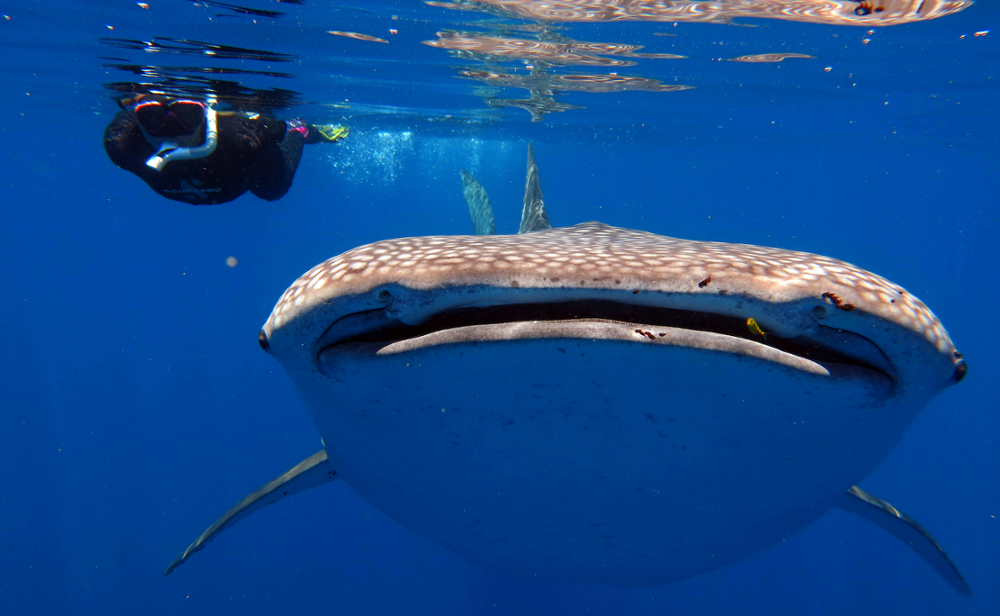
Several options are available to you to observe whale sharks in Madagascar. You can opt for a scuba diving excursion to see the world's largest fish at your level. For the most immersive experience, freediving remains your best option.
And for those who are afraid of scuba diving or descending into the depths on a single breath, know that it is entirely possible to swim with whale sharks and see them during a snorkeling excursion. Snorkeling trips to encounter Madagascar's whale sharks are indeed among the most popular experiences for travelers.
Want to see Madagascar's whale sharks while making a difference? Why not participate in a citizen science program? Created in 2016, the Madagascar Whale Shark Project is a collaborative research and conservation project for whale sharks.
The organization invites visitors to participate in data collection to "establish the abundance, residency, size and population structure of whale sharks in Nosy Be through photo-identification, tagging, and sampling".
If this type of project interests you, know that you can join the scientific team of the Madagascar Whale Shark Project on a day excursion aboard a boat from our partner "Les Baleines Rand'eau". Don't hesitate to contact us to organize your scientific adventure!
More info on baleinesrandeau.com
Is it dangerous to swim with whale sharks?
While they impress with their size and name, whale sharks are completely harmless to humans. Not only do these ocean giants feed exclusively on zooplankton and small fish, but they are also placid, calm animals devoid of any form of aggression. They move slowly and are generally curious toward humans.
Moreover, snorkeling excursions with whale sharks are accessible to all. As our partner Les Baleines Rand'eau explains: "This is an excursion and experience accessible to everyone: Even if you're not a strong swimmer, we adapt the water entries to all levels. Simply seeing it from the boat is already an unforgettable moment… "
As you can see, swimming with whale sharks is not at all dangerous and the risk of attack is virtually nonexistent. Of course, to ensure the experience is safe for you and the animal alike, you must follow certain approach rules, which we'll explore below.
How to observe whale sharks without disturbing them?
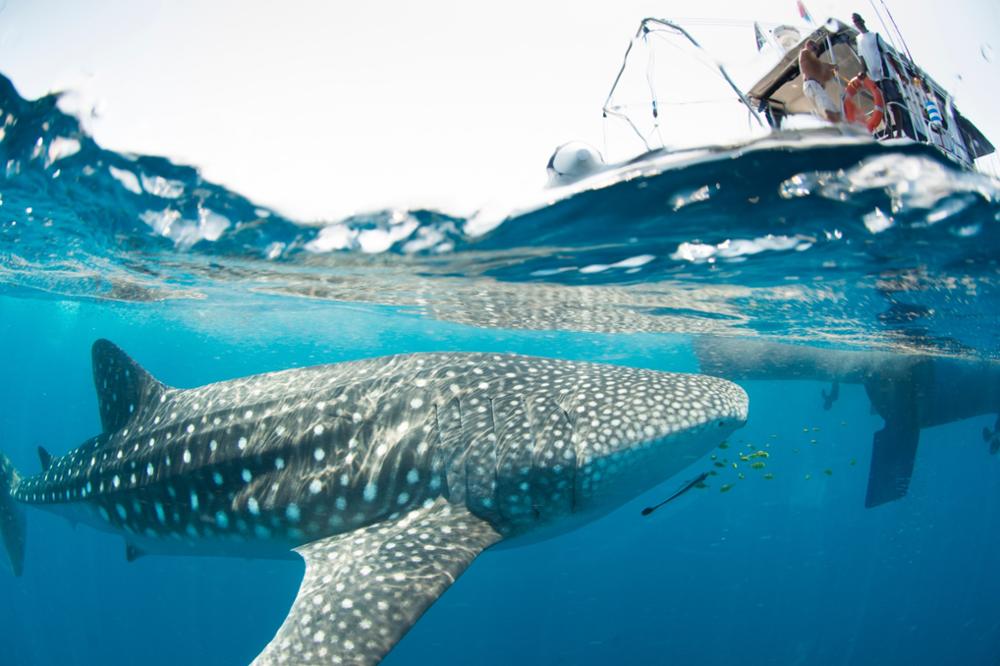
What are the rules of conduct for seeing whale sharks in Madagascar?
Since January 2024, in application of the Inter-ministerial Order no. 33626/2023 of December 20, 2023 concerning the provisions and regulations to be observed for all activities observing megafauna marine life in Madagascar, Malagasy law requires compliance with a whale shark observation charter. Established by the Madagascar Whale Shark project in 2016, the charter specifies the approach guidelines and codes.
Among the rules to follow when approaching whale sharks (for boats, guides, and tourists alike), we find:
- Only one boat is permitted around whale sharks. This boat must be more than 15 m away from the animal (other boats must wait at 150 m);
- Boats must not exceed 6 knots speed in the 150 m zone;
- The boat engine must be in neutral when swimmers enter the water;
- When entering the water, snorkelers must slip into the water and are forbidden from jumping;
- No more than 10 people (+ 1 guide) in the water around the whale shark;
- Snorkelers must never position themselves in front of the animal to avoid restricting its movements but rather on the sides or behind: no more than 4 m around the tail and no more than 3 m at the whale shark's sides;
- It is strictly forbidden to touch whale sharks, and it is forbidden to feed them;
- The use of camera flashes is not permitted;
- Swimmers are invited to remain calm and relaxed in the company of whale sharks to avoid frightening them. Abrupt movements must be avoided at all costs.
As explained by the Madagascar Whale Shark project, following these rules enables better coexistence between humans and animals and guarantees "better encounters and observations in complete safety for the sharks and for people in the water".
How to choose an ethical and marine life-respectful boat excursion?
In addition to following the code of conduct specified in the Madagascar Whale Shark project's charter, it is recommended to choose a responsible and ethical operator (whether a dive center or snorkeling excursion company). Because even though laws exist on the subject, there are still individuals who circumvent them. That's why it's important to ensure you choose an operator who respects animal welfare.
To do this, the association recommends verifying before booking that the operator adheres to this charter and that it is posted and enforced. To be sure you make the right choice, you can opt for an excursion with our partner Les Baleines Rand'eau, which adheres to the charter and organizes numerous scientific outings with the Madagascar Whale Shark project.
Need help organizing your stay in Madagascar and your whale shark encounter excursion under the right conditions? Don't hesitate to contact us!
To learn more, also discover our articles on the same subject:
- Protecting biodiversity on the island of Nosy Be
- All you need to know about diving in Madagascar
- Discovering Madagascar's biodiversity: 5 must-see destinations
- Animals to see in Madagascar
Florine Dergelet