Famadihana or the Turning of the Dead
Famadihana is a tradition that some reduce to mere exhumation, but it is far more than that. Travelers might draw a parallel with Ma'nene, a ritual practiced on the Indonesian island of Sulawesi, involving the exhumation, cleaning and dressing of the deceased. Famadihana is an altogether different tradition, unique in the world.
Famadihana is a tradition that some reduce to mere exhumation, but it is far more than that. Travelers might draw a parallel with Ma'nene, a ritual practiced on the Indonesian island of Sulawesi, involving the exhumation, cleaning and dressing of the deceased. Famadihana is an altogether different tradition, unique in the world. What are its origins? What does it entail? What is its purpose? Here are the answers.
Entry into the family tomb, entry into heaven
During the unification of the kingdoms of Madagascar by Andrianampoinimerina (1745-1810), many Merina soldiers died in battle. For the king, it was a sorrowful fate to be buried far from home. He therefore proposed that his people build family tombs, then ordered the repatriation of bodies so that the deceased could rejoin their kin. This outcome is essential, for according to belief, it is like entering heaven.
Famadihana truly became a tradition around 1814, during the reign of Andrianampoinimerina's son, Radama I (1793-1828). It began in Imerina, then was adopted by the ethnic groups that formed part of the unified kingdom. The rite is organized every 3, 5 or 7 years and the date is designated by the mpanandro of the organizing family, the diviner, shaman and traditional doctor. It always takes place during the dry season (between June and September). Part of the Christian population, however, has abandoned this tradition, due to divination and prayers addressed to ancestors. This component of Malagasy culture and identity should nevertheless be preserved in one way or another, even if it means making some modifications and challenging beliefs!
The transformation from sorrow to joy
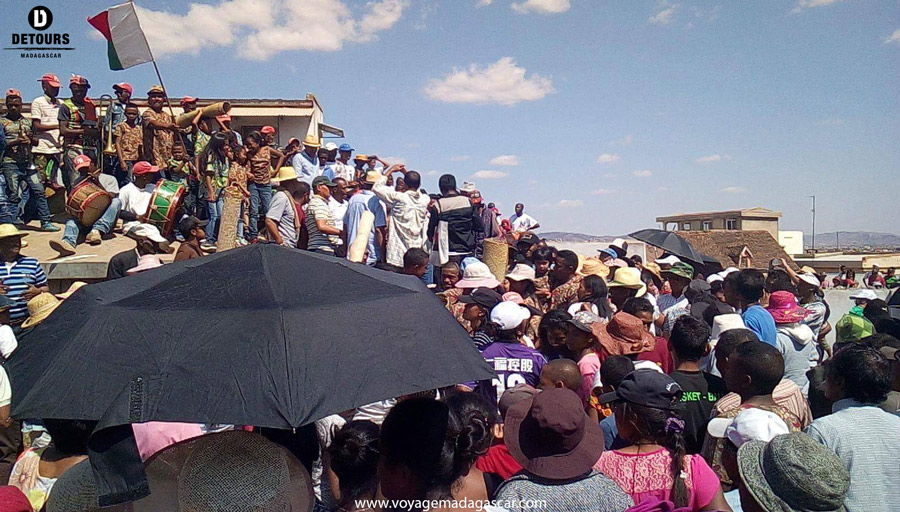
The meaning of the word "famadihana" can be "turning," but also "transformation." One of the primary objectives of this tradition is to "transform" sorrow (mourning) into joy. During the burial, there is sadness, but during famadihana, people literally rejoice. It is a grand celebration, a grand festivity for the wealthier who spend considerable sums of money! It takes place over two days. The first day (andro fidirana), one or more cattle (for eating) are slaughtered, food is prepared and music begins with celebration. The second day (famokarana), family and guests are invited to the meal. Then, those who have finished eating head to the dance floor. It is not just about eating… there is also drinking… a lot. And we are talking about alcohol.
The transformation of disagreements into fihavanana (accord, harmony and love)
Toward the afternoon, a man carrying a flag (with a whistle in his mouth) leads everyone toward the family tomb. Along the way, people dance and play music. Originally, the flute, drum and trumpet were played. Everyone celebrates and buries the hatchet, particularly the organizing family, who own the tomb. All those who have wronged each other are "obliged" to forgive, especially members of the same family. Quarrels must be left behind until new ones arise, for that is how life is lived.
The unification of the family
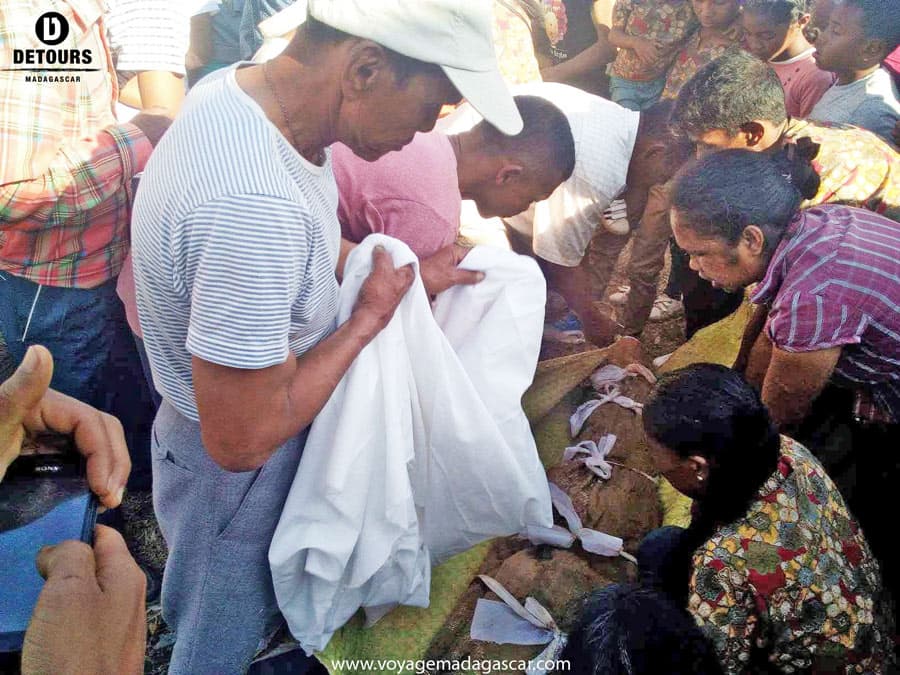
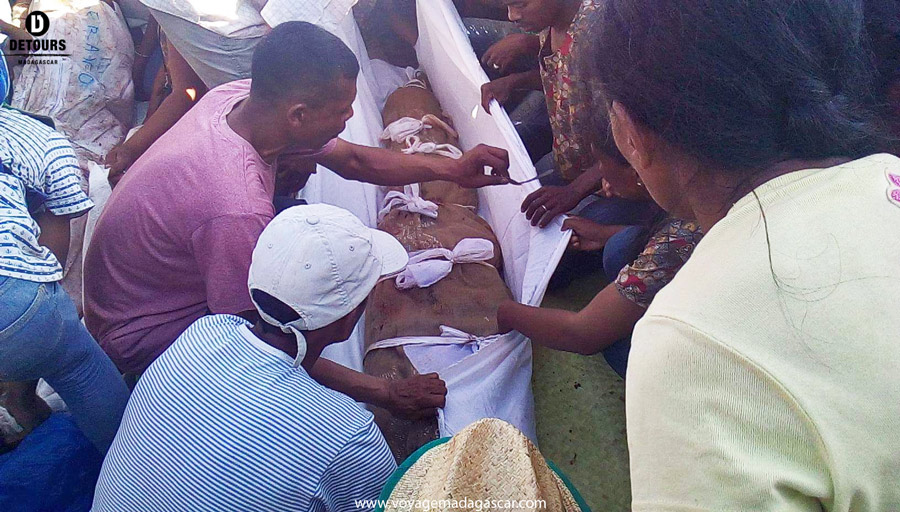
"Velona iray trano, maty iray fasana": this saying takes on full meaning during famadihana! "United in life as in death", that is what it means. It should be known that a single tomb brings together several families united by a single ancestor. Famadihana is also the moment when the dead are unified, particularly a husband and his wife. Both are wrapped together in lamba (white cloth). According to the family's decision, some deceased may also be wrapped in the same cloth. Once the family tomb is reached, it is opened. Families and those who know the location of the deceased enter to remove the bodies. These are entrusted to their closest relatives, namely their children. Small groups are then formed and each wraps their dead. Those who finish place their deceased on their knees. Throughout all these processions, music never stops. When everyone is done, they stand up and carry the deceased on their shoulders while dancing in all directions. Sorrow (mourning) is transformed into joy! The bodies are returned to the tomb in order of seniority. A speech of thanks closes the celebration.