Fanorona: Between Chess and Checkers
Fanorona is a very popular Malagasy board game that resembles checkers. When travelers on a circuit in Madagascar spot groups of men gathered around a game on the side of a street or in a park, it is most likely fanorona.
Fanorona is a very popular Malagasy board game that resembles checkers. When travelers on a circuit in Madagascar spot groups of men gathered around a game on the side of a street or in a park, it is most likely fanorona.
This strategic game is surrounded by several legends. It is said to have been created by Prince Andriantompokoindrindra in the 1600s, while others claim it was created by the first inhabitants of the Great Island. The most probable theory is that fanorona is a derivative of Alquerque, brought by Arab merchants. One of the oldest fanorona boards found in Antananarivo is the one at Alasora, dating between 1500 and 1600.
The Rules of Fanorona
The Rules of the Malagasy Game
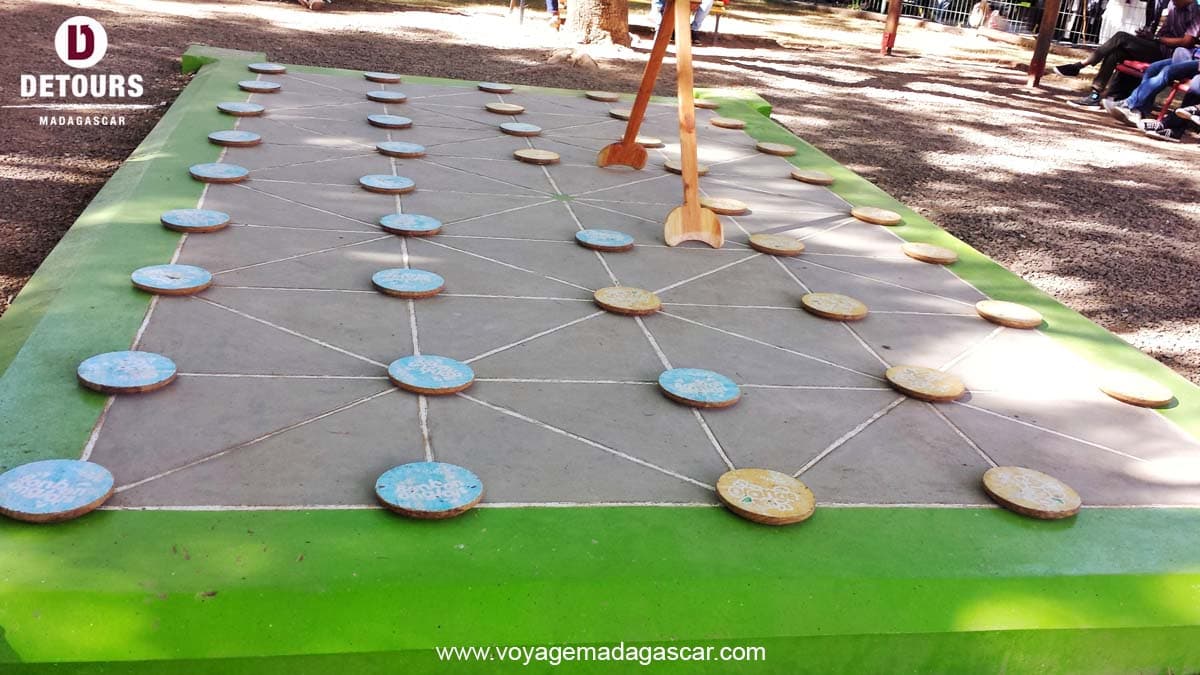
Fanorona is played on a rectangular board comprising 5 rows and 9 columns. The interior is composed of horizontal, vertical, and diagonal lines forming 45 intersection points corresponding to the positions of the pieces. Each player has 22 stones (pieces) to place on their half of the board. The center square allows for the very first move of the game. The goal is to capture all of your opponent's stones through striking or aspiration. A capture is made by moving forward (striking) to an empty space in front of the stone to be eliminated, or by moving backward (aspiration) toward the next empty space to eliminate (aspirate) the stone in front. All opposing stones on the same axis are eliminated. If both capture modes are possible, you must choose one or the other and confirm to your opponent which stones to remove, as it is your opponent who removes them from the board.
Progress of a Fanorona Game and Strategies
The first move consists of moving a stone to the center point: the only possibility at the very start. After a capture, a player may continue to capture other series of stones, provided that the movement passes through a different point or a different axis than the one played previously. They may also choose not to make an additional capture even if they have the opportunity. Early in the game, both striking and aspiration are possible with the same move, giving the player the choice of which to apply. It is best to start with small strategic captures, because starting with a series of captures leaves many free points for the opponent, allowing for larger captures later. Late in the game, each player must take their turn even if it does not result in a capture or puts them in a disadvantageous position.
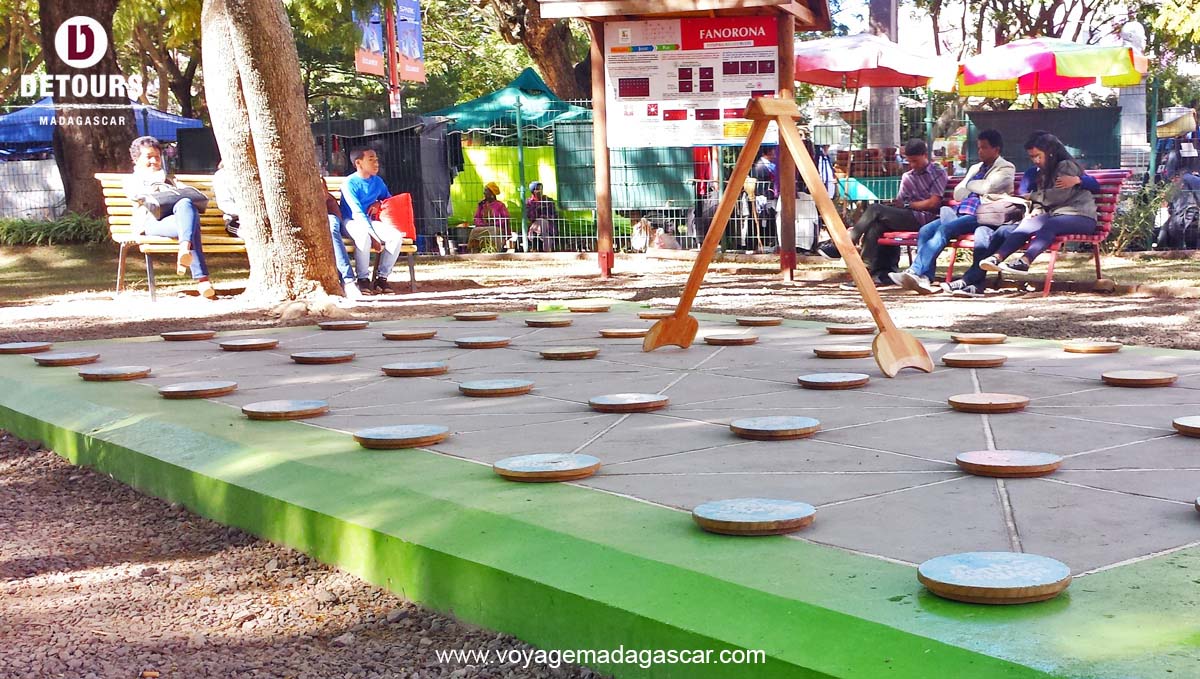
Giant Fanorona in the Antaninarenina Garden
The Importance of Fanorona for Malagasy People
Fanorona in the Daily Life of Malagasy People
This game is very popular and is played everywhere: on the roadside, in parks, at home, in taxi-brousse stations, etc. The board is drawn on a wooden plank, on a flat stone surface, directly on the earth, on cardboard, or anything that would work. The pieces (stones in Malagasy, called vato) are pebbles (originally), pieces of wood, balls of paper, chalk, or grains of different colors. Fanorona is mainly played by men to pass the time, for entertainment, or to unwind after work. It is also a way to perpetuate a heritage of great value. Since this game is highly addictive, fady (prohibitions) were even created from scratch to prevent field workers from playing fanorona during the rainy season.
Ancient Malagasy Sovereigns Who Were Fanorona Enthusiasts
Like the game of go in Asia, fanorona was once used as an introduction to war strategy. It was also employed as a means of divination. This is how the rumor arose that Queen Ranavalona III asked her advisors to play fanorona to predict the outcome of the confrontation with the French. Another story from the first half of the 17th century tells of how one of the two sons of King Ralambo missed a succession meeting because he was too absorbed in fanorona. Before that, this game was widely practiced by the aristocracy and particularly by kings and queens, as evidenced by the enormous stone block serving as the board at the rova of Ambohimanga. King Andriamasinavalona (1675–1710) is said to have been a great enthusiast.