Ankarafantsika National Park
Ankarafantsika National Park
In northwestern Madagascar, Ankarafantsika protects 136,000 hectares of dry forest, the sacred lake Ravelobe, Ankarokaroka canyon and remarkable endemic wildlife.
In the Boeny region, northwestern Madagascar, Ankarafantsika National Park covers 136,000 hectares of dense dry forest, savanna and canyons. Bounded to the east by the Mahajamba river and to the west by the Betsiboka river, crossed by National Route 4, it combines exceptional ecological richness with Sakalava cultural heritage. Formerly known as Ampijoroa Forest Station, the park today harbors more than 800 plant species, 129 bird species and 8 lemur species.
Why visit Ankarafantsika
Ankarafantsika ranks among Madagascar's rare protected areas where three contrasting environments coexist within the same territory: deciduous dry forest, grassy savanna and erosion canyon with ochre tones. This mosaic of ecosystems explains the density of endemic species, beginning with Coquerel's Sifaka, a white and rust-colored lemur that has become the park's emblem. Ornithologists will find one of the island's major sites for observing endemic birds, notably the Madagascar Fish Eagle, a threatened raptor. The park also holds strong sacred significance for the Sakalava people, who maintain traditional ceremonies there.
History and legend of Ravelobe
The name Ankarafantsika derives from "Garafantsy," a Malagasy expression meaning "mountain of thorns" or "cunning and frightening man." This double meaning refers both to vegetation bristling with prickly shrubs and to a figure in local oral tradition.
According to Sakalava legend, Ravelobe was a patriot turned bandit who ravaged these forests and spread terror among travelers. Cornered, he reportedly took his own life along with his entire family in the great lake that now bears his name. The Sakalava consider the Nile crocodiles inhabiting the lake to be Ravelobe's descendants: they are sacred and protected by fady (customary prohibitions).
The park shelters several sacred sites, including Doany, royal tombs where ceremonies such as Joro—a ritual of invocation accompanied by prayers and zebu sacrifices—still take place.
What to see in the park
The sacred lake Ravelobe
Spanning nearly 27 hectares, Lake Ravelobe is the park's central water body. Its shores concentrate observations of aquatic birds (herons, ibis, fish eagle, ducks) and harbor Rere, Malagasy freshwater turtles. Nile crocodiles are regularly visible from observation platforms.
Ankarokaroka canyon
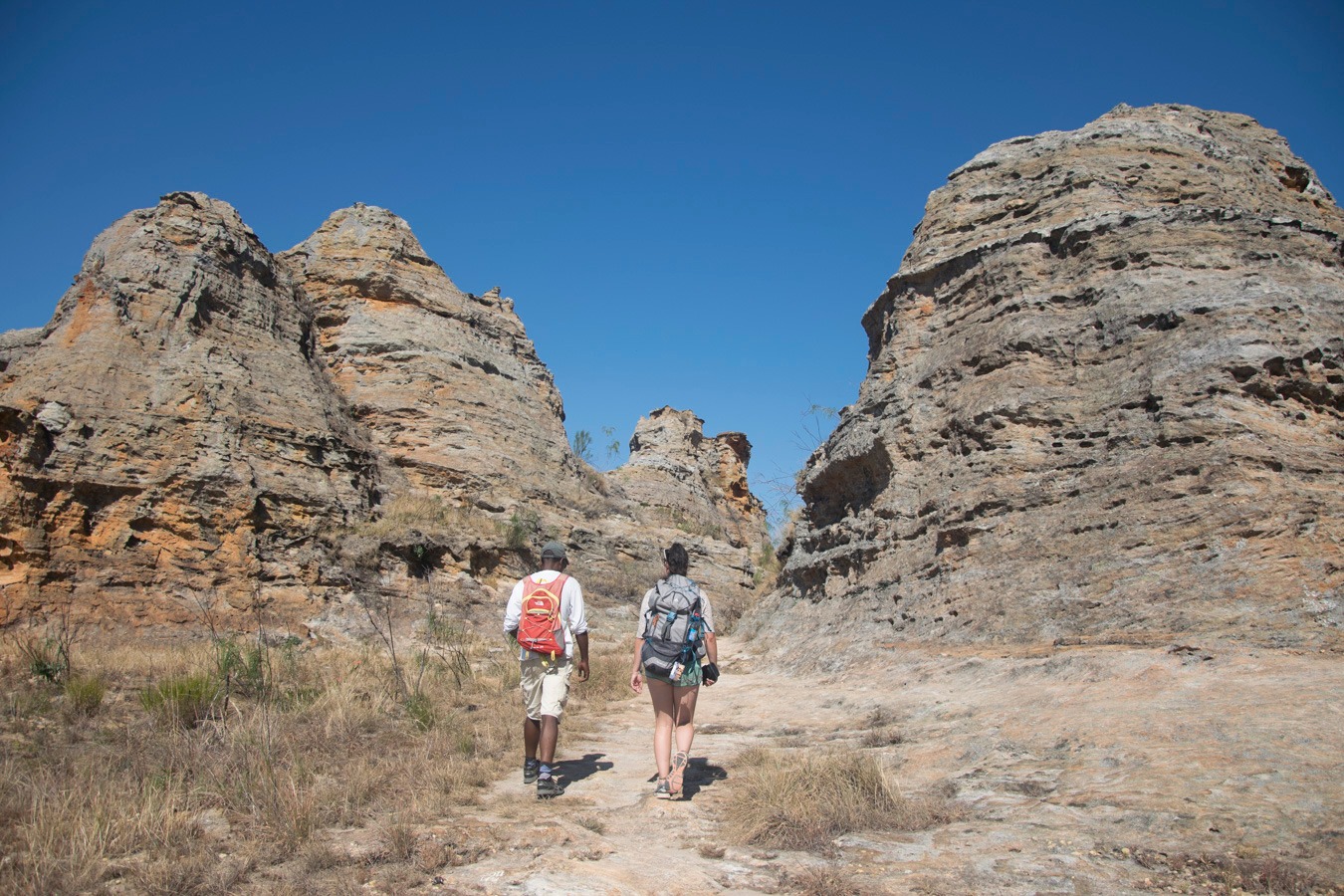
This multicolored canyon results from vast "lavaka," erosion formations typical of Madagascar's laterite reliefs. Ochre, red and white walls dominate a landscape shaped by water runoff, accessible via a panoramic trail.
Endemic fauna and flora
- Lemurs: 8 diurnal and nocturnal species, including Coquerel's Sifaka and Microcebus ravelobensis, a mouse lemur endemic to the park and one of the smallest primates in the region.
- Birds: 129 species, of which 75 are endemic according to park data, including the Madagascar Fish Eagle, Malagasy Paradise-Flycatcher, Malagasy Bulbul, Newton's Kestrel and several Vanga species.
- Reptiles and small mammals: chameleons, iguanas, snakes, tenrecs.
- Flora: more than 800 species inventoried, adapted to the sandy massif. The endemic baobab Adansonia madagascariensis var. boinensis and rosewood among the remarkable species.
When to visit
The Boeny region's climate follows a tropical rhythm with two marked seasons. The dry season, from April to November, remains the most favorable period: passable trails, facilitated wildlife observation around water points, manageable temperatures. The wet season (December-March) brings abundant rainfall and makes some trails difficult to access, but corresponds to breeding periods for many species. For birdwatching, September through November are often recommended.
Practical information
- Guided visits: visiting is mandatory with a guide approved by Madagascar National Parks, recruited at the park entrance in Ampijoroa.
- Entrance fee: moderate tariff according to Madagascar National Parks rates, with differentiation for residents/non-residents and guiding fees to add.
- Accommodation: a camp and bungalows exist at Ampijoroa, on site. Booking recommended during high season.
- Duration: allow a half-day for a short circuit (Lake Ravelobe or canyon), one to two full days to combine trails and nocturnal lemur observation.
- Equipment: walking shoes, water, sun protection, binoculars and headlamp for night outings.
How to get there
The park is crossed by National Route 4, which connects Antananarivo to Mahajanga. The main entrance is located at Ampijoroa, along this route, approximately 450 km northwest of Antananarivo and 115 km southeast of Mahajanga. Access is via shared minibus from these two cities, or by private vehicle with driver, the recommended solution for flexible stops. Mahajanga also has an airport served from Antananarivo, which allows you to shorten the approach.
What to see in the region
Madagascar offers other complementary sites during a northwest circuit or on the return route to the capital:
- Cirque rouge, spectacular erosion formation near Mahajanga.
- Lemurs' Park, lemur reserve close to Antananarivo.
- Ambatomanga, historic village of the Highlands.
Frequently asked questions
Frequently asked questions
Yes. As in all of Madagascar's national parks, accompaniment by an approved guide is mandatory. Guides are recruited on site at the Ampijoroa entrance.
The dry season, from April to November, offers the best visiting conditions. Animals concentrate around water points and trails remain passable. For birds, September through November constitutes a particularly interesting window.
Yes. Coquerel's Sifaka, the park's emblem, is regularly seen on trails near Ampijoroa. Nocturnal species like Microcebus ravelobensis require a night outing with a headlamp.
A half-day is sufficient for a short trail around Lake Ravelobe or the canyon. To explore multiple circuits and do a night outing, allow one to two full days with overnight stay at Ampijoroa.
Nile crocodiles are indeed present in the lake, but observation takes place from secured platforms and designated viewpoints. Strictly follow your guide's instructions.
Prepare your trip
Ankarafantsika National Park naturally integrates into an itinerary combining the Highlands, west coast and northwest. To build a custom itinerary including this park and other major sites, consult our Madagascar voyages.
Interested in this visit?
We can include it in your personalised itinerary.