Nosy Lonjo
Nosy Lonjo
Nicknamed the Sugarloaf of Diego Suarez, Nosy Lonjo is a sacred volcanic islet at the heart of northern Madagascar's bay, a mausoleum of Sakalava sovereigns.
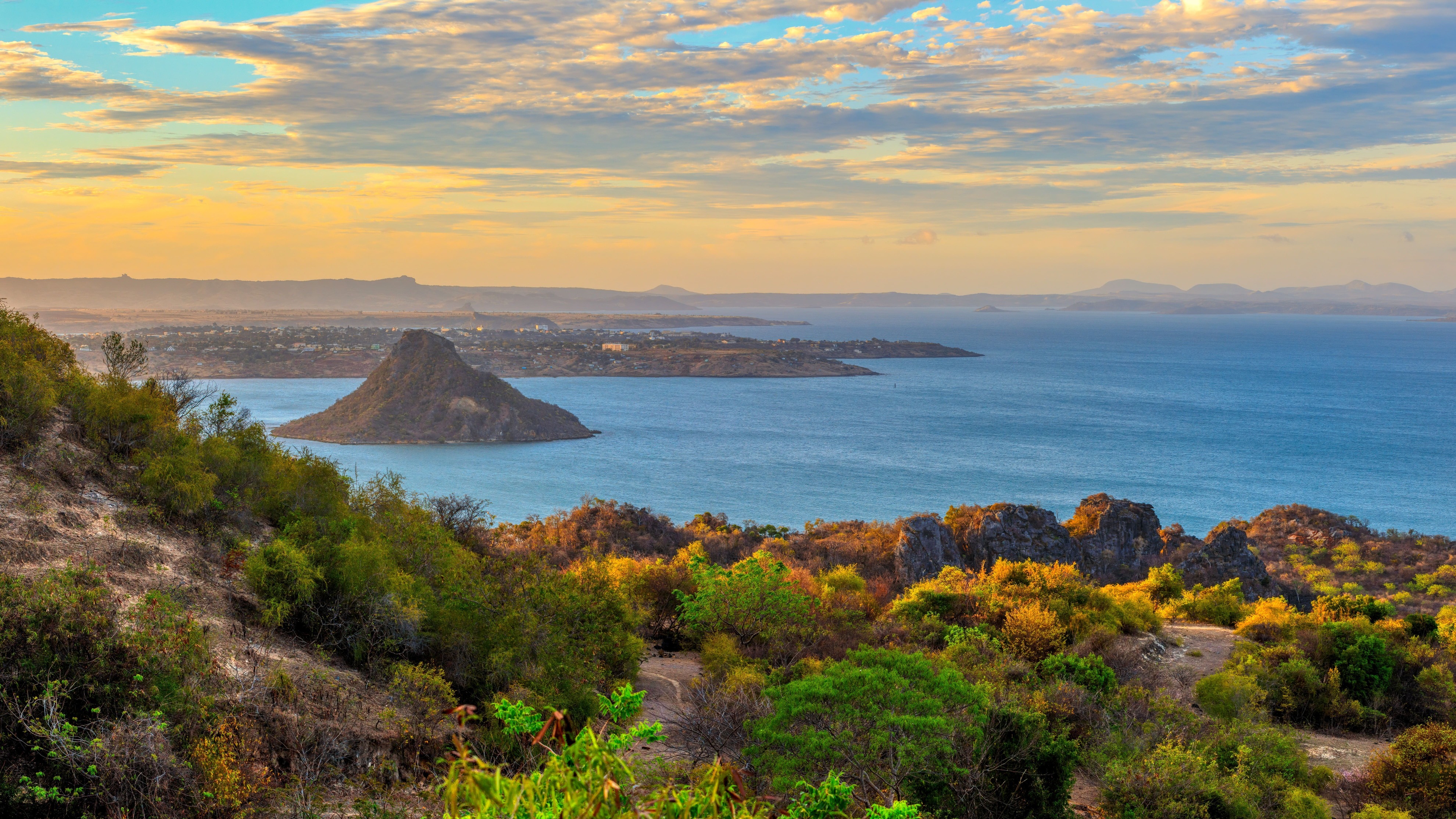
Off the coast of Diego Suarez, at the far north of Madagascar, a rocky pinnacle rises from the turquoise waters of the bay. Nosy Lonjo, nicknamed the "Sugarloaf of Diego Suarez" in reference to its Brazilian counterpart, stands its conical silhouette at the heart of a bay counted among the world's vastest. A sacred site for the Sakalava community, the islet cannot be visited but is observed from the shore or during boat excursions across the bay.
Why visit Nosy Lonjo
This volcanic islet serves as the emblematic visual landmark of Diego Suarez (Antsiranana). Its characteristic form, a verdant dome that stands out from the waters, makes it a recurring photographic subject and a point of reference from every vantage point in the city.
Beyond its aesthetic appeal, Nosy Lonjo combines several dimensions:
- A sacred status rooted in the Sakalava culture of northern Madagascar
- A coastal ecosystem where mangroves and winged fauna coexist
- A central landmark in the world's second-largest bay, often cited just after Rio de Janeiro's
- A strong identity symbol of Diego Suarez city
History and sacred status
Nosy Lonjo holds a particular place in Sakalava cosmogony, the people of Madagascar's west and north coast. According to oral tradition, the islet serves as a mausoleum for deceased Sakalava sovereigns. This funerary function confers upon the site the status of fady (taboo), forbidding access to common visitors.
Only certain customary rituals, overseen by traditional guardians, allow descendants or dignitaries to set foot on the islet. This sacred dimension explains why Nosy Lonjo, despite its proximity to the city, remains intact and preserved from mass tourism. Visitors respect this rule: one looks, photographs, but does not disembark.
The nickname "Sugarloaf" is said to have been given by analogy with the famous rock of Rio de Janeiro, a comparison that took root in local and tourism vocabulary over the course of the twentieth century.
What you observe
The silhouette and panorama
Nosy Lonjo's dome rises several dozen meters above the water and stands alone, without immediate neighboring islands, which reinforces its sculptural aspect. The best viewpoints are from Diego Suarez's waterfront, from the harbor, or from the heights near the city.
Fauna and flora
The islet harbors vegetation typical of northern Madagascar's coast: mangroves in low-lying areas, baobabs and endemic shrubs on rocky slopes. A colony of reddish fruit bats (Pteropus rufus) has made its home there; they can sometimes be spotted at dusk when they take flight in swarms toward the mainland to feed.
The bay itself
Diego Suarez's harbor, the world's second-largest bay by several classifications, offers an exceptional maritime setting. Deep waters, intricately carved peninsulas and satellite islets compose a landscape that Nosy Lonjo punctuates like a central comma.
Practical information
- Access to the islet: forbidden due to the site's sacred character. Observation is from a distance.
- Observation from land: free and open from Diego Suarez's vantage points
- Boat excursions: several Diego Suarez operators offer bay outings that pass at the foot of the islet. Moderate rates, to be negotiated on site.
- Recommended duration: plan half a day to combine a bay trip and land viewpoints
- Respect for customs: do not attempt to disembark, take no materials from the islet
When to go
Diego Suarez enjoys a tropical climate marked by two seasons. The dry season, from April to November, offers the best conditions: clear skies, calm seas, ideal light for photography. This is also when boat trips unfold in the greatest comfort.
The rainy season, from December to March, can complicate navigation and reduce visibility. The trade winds (varatraza) blow hard from May to October, which enlivens the bay without preventing excursions as long as mornings are favored.
How to get there
Diego Suarez (Antsiranana) is reached by:
- By air: domestic flights from Antananarivo to Arrachart airport, about ten kilometers from the city
- By road: the RN6 connects Antananarivo to Diego Suarez over more than 1,100 km, plan two to three days of travel
Once there, Nosy Lonjo's observation points are accessible on foot from the city center. For a boat approach, head to the harbor or book through your accommodation.
What to see nearby
The Diego Suarez region lends itself to several extensions:
- The Îlot de la Vierge, another island landmark in the bay
- The Cirque rouge and its spectacular erosion formations
- Montagne d'Ambre and Ankarana national parks, accessible from Diego
- The Three Bays (Sakalava, Pigeons, Dunes) on the peninsula's east coast
To explore other facets of the Grand Island, you may also consider the Lemurs' Park near Antananarivo or the craft village of Antoetra on the highlands.
Prepare your trip
Nosy Lonjo fits into a broader circuit through northern Madagascar, where tropical bays, national parks and Sakalava culture converge. To build a tailor-made itinerary incorporating Diego Suarez and its surroundings, consult our Madagascar trips.
Interested in this visit?
We can include it in your personalised itinerary.